Showing posts with label Nazi Figure. Show all posts

28 February 2026

Adolf Hitler and Ion Antonescu at the Schloss Kleßheim (1943)


Image size: 1248 x 832 pixel. 268 KB
Date: Monday, 12 April 1943
Place: Schloss Kleßheim, Salzburg, Austria
Photographer: Walter Frentz

This picture was taken by Walter Frentz at the Schloss Kleßheim in Salzburg, 12 April 1943. From left to right: Otto Meißner (Leiter der Präsidialkanzlei), Generalleutnant Walter Warlimont (Stellvertretender Chef des Wehrmachtführungsstabes), Paul Otto Schmidt (interpreter), Marshal Ion Antonescu (Romanian dictator and Prime Minister), unknown Romanian official, Adolf Hitler (Führer und Oberster Befehlshaber der Wehrmacht), and Generalfeldmarschall Wilhelm Keitel (Chef der Oberkommando der Wehrmacht).

By April 1943, World War II had reached a turning point on the Eastern Front following the devastating German defeat at Stalingrad earlier that year. Romania, under Marshal Ion Antonescu's authoritarian rule since 1940, remained a vital Axis ally, supplying troops, oil, and resources to Nazi Germany. However, mounting losses and the advancing Soviet forces strained the partnership. Antonescu sought reassurances from Adolf Hitler regarding Romania's territorial integrity, particularly the return of Northern Transylvania, ceded to Hungary via the 1940 Vienna Award. Hitler, facing wavering commitment from his satellites, convened a series of bilateral summits at Schloss Klessheim, a Baroque palace near Salzburg, Austria, renovated in 1940 as a luxurious guest house for diplomatic receptions. The palace, originally built in the 18th century by Prince-Archbishop Firmian, featured opulent halls, gardens, and conference rooms equipped for high-level discussions, including strategic planning with maps.

These meetings included Italian leader Benito Mussolini, Romanian Marshal Ion Antonescu, and Hungarian Regent Miklós Horthy, each held separately to bolster Axis unity. For Antonescu, the visit on April 12-13, 1943, was an opportunity to address military cooperation, economic strains, and the sensitive "Jewish question," where Germany pressured Romania to accelerate deportations as part of the Final Solution. Despite earlier alignments, Antonescu resisted full compliance, prioritizing Romanian sovereignty.

Marshal Ion Antonescu arrived at Schloss Klessheim on April 12, 1943, amid a backdrop of spring landscapes and heightened security. The palace, serving as a neutral yet grandiose venue for Axis diplomacy, was guarded by SS personnel and equipped with anti-aircraft defenses. Hitler personally welcomed Antonescu, a gesture reflecting the Romanian leader's importance as a key supplier of oil and manpower. Accompanied by German Foreign Minister Joachim von Ribbentrop and other officials, the two leaders exchanged formal salutes and handshakes before proceeding to the palace's interior. Newsreel footage and photographs captured the arrival, emphasizing the ceremonial aspects of the visit.

The two-day summit included private discussions and formal receptions, with Antonescu's delegation including advisors focused on military and economic matters. The atmosphere was tense, as both sides grappled with the war's deteriorating outlook.

The centerpiece of the visit was a strategic conference held in one of Schloss Klessheim's equipped rooms, where Hitler and Antonescu reviewed military maps spread across a large table. Joined by high-ranking officers such as Field Marshal Wilhelm Keitel and Walter Warlimont, the leaders discussed the Eastern Front's challenges, Romania's ongoing contributions, and future operations. Hitler urged Antonescu to maintain commitment despite recent setbacks, criticizing other allies for insufficient effort while praising Romania's role.

A significant portion of the talks addressed the "Jewish question." Germany intensified pressure on Antonescu to deport Romanian Jews to extermination camps in occupied Poland, following earlier plans discussed in 1942. Antonescu, aware of the deportations' lethal implications, resisted, citing Romania's independent approach and refusing to yield without concessions like the return of Northern Transylvania. The discussions also touched on economic cooperation, with Romania's oil fields critical to the German war machine, and territorial assurances against Hungarian and Bulgarian claims.

The map room setting allowed for detailed examination of frontline positions, supply lines, and potential counteroffensives, underscoring the military dimension of the alliance. Follow-up talks on April 14 involved Ribbentrop and Mihai Antonescu, Romania's Foreign Minister, further emphasizing resistance to German demands on deportations.

The April 1943 summit at Schloss Klessheim highlighted the fragility of the Axis coalition. While Hitler sought to rally his allies, Antonescu's visit revealed growing Romanian disillusionment with the war. Antonescu secured no firm commitments on Transylvania but maintained Romania's autonomy on internal policies, notably halting Jewish deportations from core territories. This resistance marked a divergence from full Nazi compliance, influenced by shifting war fortunes.

In the ensuing months, Romania's position worsened, leading to secret overtures to the Allies. By August 1944, King Michael orchestrated a coup, arresting Antonescu and switching sides to the Allies. Antonescu was tried and executed in 1946 for war crimes. Schloss Klessheim, once a hub of Axis diplomacy, now houses a casino and serves as a reminder of wartime intrigue. The meeting exemplifies the personal dynamics between Hitler and his allies, blending strategy, ideology, and pragmatism in the face of impending defeat.


Source:
https://www.walter-frentz-collection.de/fotoarchiv/personenarchiv-a-z/personen-a-b/

04 September 2021

Hitler Arrived in an Airfield in Poland


Image size: 2048 x 1339 pixel. 1 MB
Date: Monday, 25 September 1939
Place: Alexandrow Airfield, between Bzura and the Vistula River, Poland
Photographer: Kriegsberichter Falk of Propaganda-Kompanie 367 (Ost)

On 25 September 1939, Adolf Hitler flew from Zoppot to the area around Warsaw, Poland. He made visits to the 8. Armee (General der Infanterie Johannes Blaskowitz) and 10. Armee (General der Artillerie Walther von Reichenau), as well as the German army headquarters in Grodjisk Mazowieki. After that he returned to Godentow-Lanz by airplane. The next day (26 September 1939 at 09:30 am), Hitler returned to Berlin boarding the Führersonderzug "Amerika". He arrived in the German capital at 17:05 in the afternoon. The Führer only returned to Poland again on 5 October 1939 to take part in the German victory parade. This photo was taken by Kriegsberichter Falk from Propaganda-Kompanie 367 (Ost) on 25 September 1939 in the area of 10. Armee, which located between Bzura and the Vistula River (facing west of Warsaw), and shows the moment Hitler had just arrived at the nearest airfield at Alexandrow. For the identification, front row from left to right: General der Artillerie Franz Halder (Chef des Generalstabes des Heeres), Reichsleiter Martin Bormann (Persönlicher Sekretär bzw. Stabsleiter des Stellvertreters des Führers Rudolf Hess), Generaloberst Gerd von Rundstedt (Oberbefehlshaber Heeresgruppe Süd), Generaloberst Walther von Brauchitsch (Oberbefehlshaber des Heeres), Generaloberst Wilhelm Keitel (Chef Oberkommando der Wehrmacht), Adolf Hitler (Führer und Oberster Befehlshaber der Wehrmacht), Generalmajor Erwin Rommel (Kommandeur Führer-Begleit-Bataillon), General der Artillerie Walther von Reichenau (Oberbefehlshaber 10. Armee), Generalmajor Friedrich Paulus (Chef des Generalstabes 10. Armee), and SS-Gruppenführer Karl Wolff (Verbindungsoffizier zwischen dem Reichsführer-SS und dem Führerhauptquartier).


Source :
Bundesarchiv Bild 101I-013-0060-20
http://alifrafikkhan.blogspot.com/2016/09/kunjungan-adolf-hitler-ke-front.html

24 January 2021

Reception for Soviet's Foreign Minister at Hotel Kaiserhof

Image size: 2048 x 1492 pixel. 302 KB
Date: Wednesday, 13 November 1940
Place: Hotel Kaiserhof, Berlin, Germany
Photographer: Unknown

At the Hotel Kaiserhof, left to right: Head of the personal staff of German Foreign Ministry Walther Hewel (2 January 1904 – 2 May 1945), German Minister of Foreign Affairs Joachim von Ribbentrop (30 April 1893 - 16 October 1946); Head of the Defense and Economic Office of the Wehrmacht General der Infanterie Georg Thomas (29 February 1890 - 29 December 1946), State Minister of the Rank of a Federal Minister and Chief of the Presidential Chancellery of the Führer and Reich Chancellor Doctor Otto Meissner (13 March 1880 - 27 May 1953); and Soviet People's Commissar for Foreign Affairs Vyacheslav Mikhailovich Molotov (9 March 1890 - 8 November 1986). Ribeentrop threw a lavish reception for the Soviet delegation at the Hotel Kaiserhof, just down Wilhelmstrasse from the German Foreign Ministry. Molotov was in Berlin to discuss joining the Axis Powers. the day before, Reichkanzler Adolf Hitler could not convince Molotov to give up Soviet interests in the Balkans. Hitler did not even attend the Kaiserhof reception or the Soviet reception at their embassy the next day. Molotov left Berlin without the Soviet Union joining the Axis. General Thomas, in charge of economic cooperation with the Soviet Union, wrote after the war, "The Russians executed their deliveries up to the eve of the attack, and in the last days the transport of rubber from the Far East was expedited by express trains." After being implicated in the July 20 plot, Thomas survived a concentration camp. He died in American captivity in 1946. Ribbentrop was hung as a war criminal. Meissner survived the war and wrote his memoirs. The Hotel Kaiserhof was leveled by British bombs in 1943; the North Korean Embassy stands there today.


Source :
https://worldwar2database.com/gallery/wwii0244

01 January 2021

Germany's Heroes Remembrance Day 1940


Image size: 2048 x 1370 pixel. 457 KB
Date: Sunday, 10 March 1940
Place: Unter den Linden, Berlin, Germany
Photographer: Unknown

Heldengedenktag (Heroes Remembrance Day) 1940 on Unter den Linden boulevard in Berlin. Reich Chancellor Adolf Hitler, accompanied by Reich Marshal Hermann Göring, Grand Admiral Erich Raeder and Reichsführer-SS Heinrich Himmler, greets the honor battalion of the Wehrmacht marching past. March 10, 1940. In 1919, the German War Graves Commission (Volksbund Deutsche Kriegsgräberfürsorge) proposed a Volkstrauertag (people's day of mourning) for German soldiers killed in the First World War. It was first held in 1922 in the Reichstag. In 1926, Volkstrauertag became a feature on what Catholics considered Reminiscere (the second Sunday of Lent.). On 27 February 1934, the National Socialists introduced national holiday legislation to create Heldengedenktag ("Day of Commemoration of Heroes"), cementing the observance. In the process, they completely changed the character of the holiday: the emphasis shifted to hero worship rather than remembering the dead. Furthermore, five years later the Nazis abolished Buß- und Bettag as a non-working day and moved its commemoration to the following Sunday, to further the war effort. Joseph Goebbels as Propaganda Minister, issued guidelines on content and implementation, instructing that flags no longer be flown at half-mast. The last Heldengedenktag was celebrated in 1945. Photo by Popperfoto.


Source :
https://en.wikipedia.org/wiki/Volkstrauertag
https://www.facebook.com/photo/?fbid=412210326714464&set=gm.1641608349357915

27 March 2018

Eichenlaub Award Ceremony for Panzer Ace Otto Carius


Image size: 1600 x 1154 pixel. 304 KB
Date: Tuesday, 2 January 1945
Place: Outskirts of Salzburg, Austria
Photographer: SS-Kriegsberichter Ege

Reichsführer-SS Heinrich Himmler (Oberbefehlshaber Heeresgruppe Oberrhein) awarded the Ritterkreuz des Eisernen Kreuzes mit Eichenlaub #535 to Oberleutnant der Reserve Otto Carius from schwere Panzer-Abteilung 502. The picture was taken by SS-Kriegsberichter Ege on 2 January 1945 at the outskirts of Salzburg (Austria). The ceremony was quite extraordinary because Carius had already received the announcement of his award from 27 July 1944, but the ceremony was postponed until five months later! This is because the panzer ace was seriously injured by a multiple shot in the seven parts of his body (including the neck!) only a few days before he suppsosedly received the Eichenlaub, so he had to be taken to the intensive care for months at Feldlazarett (Field Hospital). Carius received the news of his award through newspapers when lying weak on the bed, and was only able to walk with his feet in September 1944. When this photograph was taken, he was no longer in charge of schwere Panzer-Abteilung 502 but had already been transferred to Panzer-Ersatz- und Ausbildungs-Abteilung 500. Another interesting fact is that the handed-over ceremony was performed by Himmler, whereas the Eichenlaub-grade medal ceremony and above was usually attended by Hitler directly. This is because from the end of 1944 the Führer began to restrict his public activities - along with the deterioration of the war situation - so that such activities were then represented to his closest confidants such as Himmler and Göring. Carius dedicated a chapter about this moment in his book 'Tigers in the Mud': "My first impressions of this man, whom his opponents called a 'bloodhound', had really pleasantly surprised me. I wasn't apprehensive about the upcoming 'cozy' conversation anymore. I described my visit with Heinrich Himmler in such detail, because he really surprised me. After the conversation in his staff headquarters , I gathered some hope for a successful conclusion to the war. That was after I had already considered a defeat almost certain."


Source :
https://ritterkreuztraeger.blogspot.co.id/2018/03/eichenlaub-award-ceremony-for-panzer.html

03 December 2014

Adolf Hitler on his Release from Landsberg Prison


Image size: 1600 x 982 pixel. 550 KB
Date: Saturday, 20 December 1924
Place: Landsberg Prison, Landsberg am Lech, Bavaria, Germany
Photographer: Heinrich Hoffmann

Adolf Hitler, age 35, wearing trench coat posed beside a gray Marcedes-Benz 11/40 (model number RIO 4346) on his release from Landsberg Prison, on December 20, 1924, after serving only nine months. He had been charged and convicted for high treason for attempting to seize power in Germany in the failed Munich Putsch coup the previous year. He spent 264 days behind bars in total. It was in this period that Hitler wrote the book that would become the literary backbone to Nazi ideology: "Mein Kampf", or "My Struggle". It was written with the help of Rudolf Hess, his deputy, who had also been involved in the Putsch and sent to prison. A combination of Hitler’s personal story and political ideology, Mein Kampf set out Hitler’s vision for Germany’s future, including the extermination of the Jewish people. Eventually ran to two volumes. A Landsberg prison official reportedly said Hitler hoped the profits from the tract would enable him “to fulfill his financial obligations and to defray the expenses incurred at the time of his trial”. Eight years later, Hitler would be sworn in as Chancellor of Germany, in 1933.


Source:
http://www.hermann-historica.de/auktion/hhm63.pl?db=kat63_r.txt&f=ZAEHLER&c=64&t=temartic_R_D&co=1
http://www.theatlantic.com/infocus/2011/06/world-war-ii-before-the-war/100089/

02 December 2014

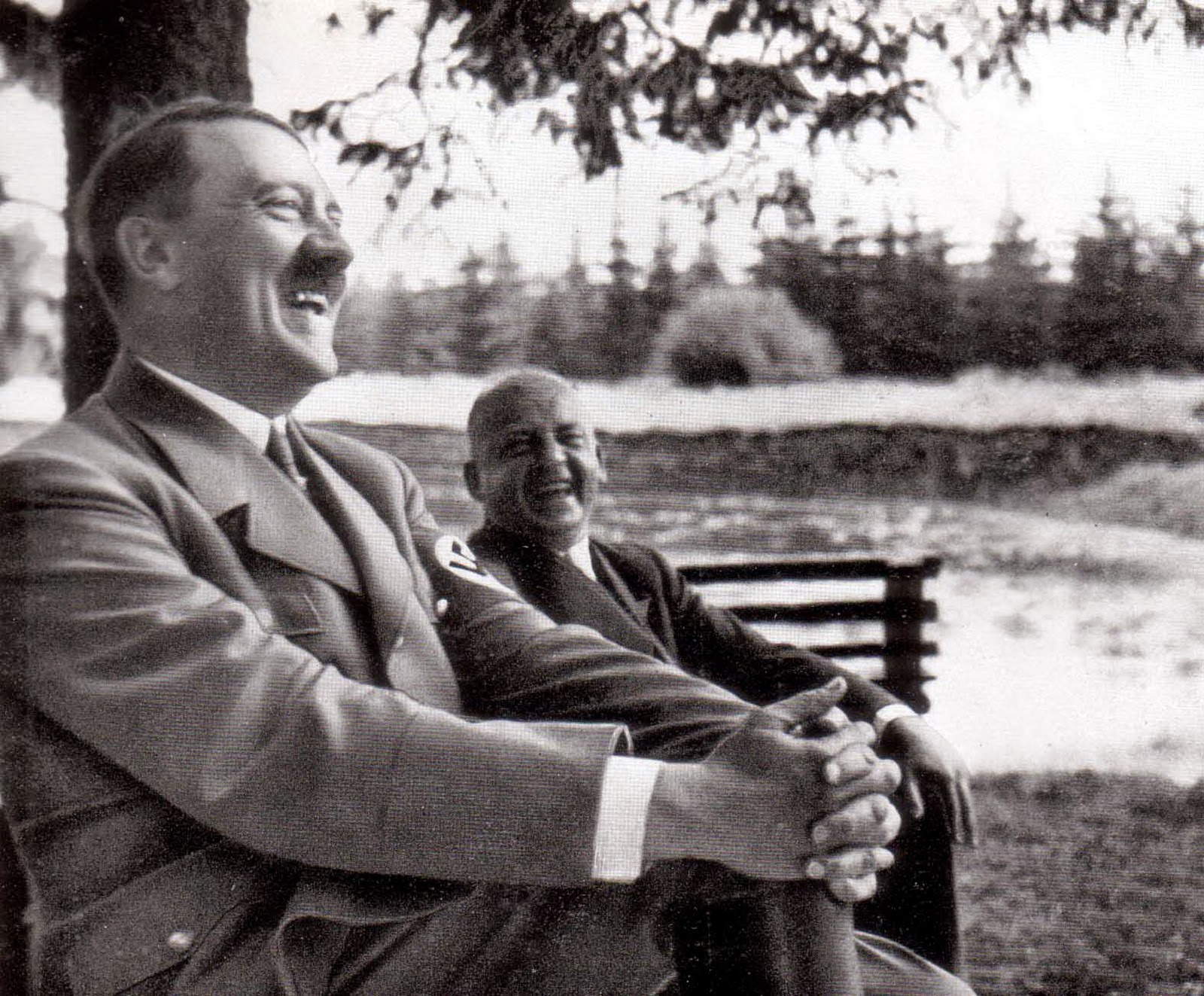
Adolf Hitler Laughing at a Vacation in Harz Mountains


Image size: 1600 x 1323 pixel. 733 KB
Date: 17-21 July 1935
Place: Harz mountains, Germany
Photographer: Heinrich Hoffmann

Original postcard caption "Eine lustige Erholungsstunde während der Fahrt" (A funny recreation hour in motion). Adolf Hitler (Führer und Reichskanzler) sitting on a bench and laughing while listening to a humorous accordeon plays performed by Arthur Kannenberg, Hitler's chief butler (Küchenchef). This picture was taken by Hitler personal photographer, Heinrich Hoffmann, during a trip to the Harz mountains (Northern Germany), 17-21 July 1935. The man sitting with Hitler (and also laughing with him) is Adolf Wagner (Gauleiter München-Oberbayern). The Führer was said to be particularly fond of a couple jokes and told the best ones over and over. One joke that Hitler liked to tell was at the expense of his pompous Luftwaffe chief Hermann Göring, a man forever designing himself new uniforms and giving himself new orders and decorations. “One day,“ Hitler used to say, “Mrs. Göring came into the bedchamber and found her husband waving his Field Marshall‘s baton over his underwear. 'Hermann, darling, what are you doing?‘ she enquired. Göring answered, 'I am promoting my underpants to overpants!'"

Source:
http://collections.yadvashem.org/photosarchive/en-us/62360.html
http://www.dailymail.co.uk/news/article-1028813/Hitler-comedian-The-Nazi-leaders-bodyguard-reveals-different-dictator.html
http://elektra.bsb-muenchen.de/jsp/frames/documentframe.jsp;jsessionid=6A326AED71185862B8D368590DD77E36?database=BILDARC@BSBBild$1&position=1&timeout=10
http://www.germanpostalhistory.com/php/viewitem.php?itemid=52733&germany%20cover=search&#littlepic0


19 November 2014

Adolf Hitler Inspecting Gustav


Image size: 1600 x 1233 pixel. 601 KB
Date: Sunday, 4 April 1943
Place: Reichswerke Hermann Göring, Linz, Germany
Photographer: Walter Frentz

This picture was taken by Walter Frentz in 4 April 1943 at Reichswerke Hermann Göring, Linz (Germany), when Hitler visited the Eisenbahngeschütz 80 cm Kanone Schwerer Gustav. FLTR: Generalleutnant Walter Buhle (Chef vom Heeresstab im Oberkommando der Wehrmacht), Ingenieur Erich Müller (Wehrwirtschaftsführer), Generalfeldmarschall Wilhelm Keitel (Chef des Oberkommando der Wehrmacht), Reichsleiter Martin Bormann (Stabsleiter im Amt des Stellvertreters des Führers), Adolf Hitler (Führer und Reichskanzler), Prof.Dr.-Ing.Albert Speer (Reichsminister für Rüstung und Kriegsproduktion), and SS-Gruppenführer Julius Schaub (not visible in this picture, Chefadjutant des Führers Adolf Hitler). Schwerer Gustav (Heavy Gustaf or Great Gustaf) was the name of a German 80 cm K (E) railway gun. It was developed in the late 1930s by Krupp as siege artillery for the explicit purpose of destroying the main forts of the French Maginot Line, the strongest fortifications then in existence. The fully assembled gun weighed nearly 1,350 tonnes, and could fire shells weighing seven tonnes to a range of 47 kilometres (29 mi). The gun was designed in preparation for the Battle of France, but was not ready for action when the battle began, and in any case the Wehrmacht's Blitzkrieg offensive through Belgium rapidly outflanked and isolated the Maginot Line's World War I-era static defenses, forcing them to surrender uneventfully and making their destruction unnecessary. Gustav was later employed in the Soviet Union at the siege of Sevastopol during Operation Barbarossa, where among other things, it destroyed a munitions depot buried in the bedrock under a bay. The gun was moved to Leningrad, and may have been intended to be used in the Warsaw Uprising like other German heavy siege pieces, but the rebellion was crushed before it could be prepared to fire. Gustav was destroyed near the end of the war in 1945 to avoid capture by the Red Army. It was the largest-calibre rifled weapon ever used in combat, the heaviest mobile artillery piece ever built in terms of overall weight, and fired the heaviest shells of any artillery piece. It is only surpassed in calibre by the British Mallet's Mortar and the American Little David mortar (both 36 inch; 914 mm).


Source:
http://elektra.bsb-muenchen.de/servlet/Top/frames/hitsframe#bildarc
http://en.wikipedia.org/wiki/Schwerer_Gustav

18 November 2014

Adolf Hitler Inspecting Dora


Image size: 1600 x 1133 pixel. 387 KB
Date: Friday, 19 March 1943
Place: Rügenwalde, Pomerania, Germany
Photographer: Walter Frentz

On 18-19 March 1943 Hitler visited the town of Rügenwalde/Pomerania (Germany) to see the 80 cm. Eisenbahngeschütz "Dora", the largest gun in the world. While Hitler was there the gun fired two granates. This picture was taken in 19 March 1943 by Walter Frentz and shows, from left to right: General der Artillerie Alfred Jodl (Chef Wehrmacht-Führungsamt), SS-Oberführer Prof. Dr.-Ing. e.h. mult. Ferdinand Porsche (Vorsitzender der Panzerkommission), Generaloberst Heinz Guderian (Generalinspekteur der Panzertruppen), Generalleutnant Walter Buhle (Chef vom Heeresstab im Oberkommando der Wehrmacht), Adolf Hitler (Führer und Reichskanzler), Generalfeldmarschall Wilhelm Keitel (Chef des Oberkommando der Wehrmacht), Hauptdienstleiter Dipl.-Ing. Karl-Otto Saur (Staatssekretär im Reichsministerium für Rüstung und Kriegsproduktion), and SS-Gruppenführer Julius Schaub (Chefadjutant des Führers Adolf Hitler). Dora was the second giant railway gun to be produced by Germany. It was deployed briefly against Stalingrad, where the gun arrived at its emplacement 15 kilometers (9.3 mi) to the west of the city sometime in mid-August 1942. It was ready to fire on 13 September. It was quickly withdrawn when Soviet encirclement threatened. When the Germans began their long retreat they took Dora with them. Dora was broken up before the end of the war, being discovered in the west by American troops some time after the discovery of Schwerer Gustav.


Source:
http://rarehistoricalphotos.com/heavy-gustav-hitler-generals-inspecting-largest-caliber-rifled-weapon-ever-used-combat/

16 January 2014

Hitler Assembles The Reichsleiter and Gauleiter After July 1944 Attempt


Image size: 1600 x 1065 pixel. 516 KB
Date: Friday, 4 August 1944
Place: Führerhauptquartier Wolfsschanze, Rastenburg, Ostpreußen/East Prussia
Photographer: Unknown

4 August 1944: After the assassination attempt of 20 July 1944 Adolf Hitler assembles the Reich (Reichsleiter) and Gau (Gauleiter) Leadership at the Wolfschanze to render homage to him. A demonstration of the unity of the NSDAP political leadership. Reichsleiter (national leader or Reich leader) was the second highest political rank of the NSDAP, next only to the office of Führer. Reichsleiter also served as a paramilitary rank in the Nazi Party and was the highest position attainable in any Nazi organisation. A Gauleiter was the party leader of a regional branch of the NSDAP (more commonly known as the Nazi Party) or the head of a Gau or of a Reichsgau. Gauleiter was the second highest Nazi Party paramilitary rank, subordinate only to the higher rank Reichsleiter and to the position of Führer. During World War II, the rank of Gauleiter was obtained only by direct appointment from Adolf Hitler.

Source:
Fotos aus dem Führerhauptquartier - Hermann Historica München

26 December 2013

Hermann Göring and His Lion Cub


Image size: 1600 x 1146 pixel. 380 KB
Date: Sunday, 5 April 1936
Place: Carinhall Castle, Berlin, Germany
Photographer: Unknown

Hermann Göring (Oberbefehlshaber der Luftwaffe) with his pet lion cub, Cäsar (some sources said as Mucki), pictured in his grandiose Carinhall castle, 5 April 1936. Göring and his wife Emma Sonnemann (known as Emmy Göring after married) lived in a castle outside Berlin named Carinhall after Göring’s first wife Carin Fock (imagine being Emmy and living in that house!). Göring’s lavish possessions there included a bowling alley, a train set appraised at $265,000 — and a private zoo that “required enough meat to feed a village"! In that zoo was a lion, or, rather, several lions, including the one in the picture. Therein lies another clue about Göring and the lion: Göring maintained close ties with zoologists and animal lovers, particularly those interested in big game animals, around Germany. Partly, this was because he was a big game hunter. But Göring’s love of animals went beyond his desire to kill them. In fact, Göring was a humanitarian when it came to large animals. He personally protected a herd of several dozen Polish bison, two thirds of whom survived the war as a direct consequence of Göring’s actions. In 1945, Berlin Zoo keeper Fritz Schneider complained that Göring had offered to evacuate the entire zoo to Carinhall in case of bombing, but had failed to do so (in fact, Göring couldn’t have saved the animals, since he’d already dynamited his castle). In addition, this website claims that Göring reintroduced buffalo and elk to German grasslands and threatened to send local townspeople to concentration camps if they killed large animals around Carinhall, including wild boars! We find ourselves at a surprising, but inescapable conclusion: Hermann Göring, the butcher of European Jewry, showed surprising tenderness, if not love, toward his pet lions. What are we to make of this? It’s easy to conclude that the strange difference in behavior is merely an example of Göring’s villainy, or, following Hannah Arendt, that it reflects “the banality of evil.” Alternately, we could agree with art curator Nancy Yeide, who concludes that the lions reflect a love of excess inherent in Göring’s character. Certainly, ownership and close contact with big cats is regarded today as a sign of extreme decadence.

Source:
http://herbertcroly.wordpress.com/2010/07/03/goerings-lion/
http://www.loc.gov/pictures/item/2002716250/

<iframe width="420" height="315" src="//www.youtube.com/embed/W5_sHxIgGwc" frameborder="0" allowfullscreen></iframe>

19 June 2013

Adolf Hitler and Hermann Göring at the Demonstration of Hetzer


Image size: 1138 x 1600 pixel. 698 KB
Date: Thursday, 20 April 1944
Place: Near Schloss Klessheim, Wals-Siezenheim, Austria
Photographer: Walter Frentz

Adolf Hitler (Führer und Reichskanzler; Oberbefehlshaber der Wehrmacht; Oberbefehlshaber des Heeres) and Reichsmarschall Hermann Göring (Oberbefehlshaber der deutschen Luftwaffe) at the demonstration of the newly developed Hetzer tank destroyer at a closed highway near Klessheim Palace (Schloss Klessheim), west of Salzburg (Austria), on the occasion of Adolf Hitler's 55th birthday, 20 April 1944. In the left behind Hitler wearing ledermantel (leather jacket) is General der Flieger Karl-Heinrich Bodenschatz (Chef des Ministeramts im Reichsluftfahrtministerium und gleichzeitig Verbindungsoffizier Görings zu Hitler), while in the far left (face cropped) is Generalfeldmarschall Wilhelm Keitel (Chef des Oberkommandos der Wehrmacht). Last, the man wearing black hat behind Göring is Dr. Ferdinand Porsche (Austrian-German automotive engineer).

Source:
http://www.ww2shots.com/gallery/v/People/Adolf+Hitler/Hitler+und+Hermann+G_ring-color+photo-ww2shots-people.jpg.html

18 June 2013

Defendants in the Beer Hall Putsch trial


Image size: 1600 x 1075 pixel. 369 KB
Date: Tuesday, 1 April 1924
Place: München, Bayern/Bavaria, Germany
Photographer: Heinrich Hoffmann

The participants of the ill-fated Nazi Münich Putsch (better known as Beer Hall Putsch) posed together for the camera as defendants during the Ludendorff-Hitler trial – April 1, 1924. From left to right: Oberleutnant Heinz Pernet (5 September 1896 - 30 June 1973), Dr. Friedrich Weber (30 January 1892 - 19 July 1955), Dr. Wilhelm Frick (12 March 1877 – 16 October 1946), Oberstleutnant Hermann Kriebel (20 January 1876 - 16 February 1941), General der Infanterie a.D. Erich Ludendorff (9 April 1865 - 20 December 1937), Adolf Hitler (20 April 1889 - 30 April 1945), Oberleutnant der Reserve Wilhelm Brückner (11 December 1884 - 18 August 1954), Ernst Röhm (28 November 1887 – 2 July 1934), and Robert Wagner (13 October 1895 - 14 August 1946). Note that only two of the defendants (Hitler and Frick) were dressed in civilian clothing. Also, Kriebel and Ludendorff wearing pickelhaube (spiked German helmet). BTW, Pernet was Erich Ludendorff's stepson. The Beer Hall Putsch was a failed attempt at revolution that occurred between the evening of 8 November and the early afternoon of 9 November 1923, when Nazi Party leader Adolf Hitler, Generalquartiermeister Erich Ludendorff, and other heads of the Kampfbund unsuccessfully attempted to seize power in Münich.

Source:
Bundesarchiv Bild 102-00344A
http://en.wikipedia.org/wiki/Beer_Hall_Putsch

05 December 2012

Hermann Göring Makes Final Statement To The International Military Tribunal at Nuremberg


Image size: 1600 x 1335 pixel. 275 KB
Date: Friday, 31 August 1945
Place: Nürnberg, Bavaria, Germany
Photographer: Unknown

Former Reichsmarschall Hermann Göring (January 12, 1893 - October 15, 1946), delivers his final statement to the International Military Tribunal. Göring denied any complicity in the Holocaust, saying, "I stand up for the things that I have done, but I deny most emphatically that my actions were dictated by the desire to subjugate foreign peoples by wars, to murder them, to rob them, or to enslave them, or to commit atrocities or crimes. The only motive which guided me was my ardent love for my people, its happiness, its freedom, and its life. And for this I call on the Almighty and my German people to witness." Göring, who had joined the Nazi Party in 1922 and risen to become Reichskanzler (Reichchancellor) Adolf Hitler's second in command, was convicted on October 1, 1946 of conspiracy to commit crimes against peace; waging a war of aggression; war crimes; and crimes against humanity. Back row, left to right: Kriegsmarine (German Navy) Grossadmiral (Grand Admiral) Karl Dönitz (September 16, 1891 - December 24, 1980) sentenced to ten years; Grossadmiral Erich Raeder (April 24, 1876 - November 6, 1960), sentenced to life imprisonment and released due to ill health on September 26, 1955; head of the Hitler Jugend (HJ, Hitler Youth) Baldur von Schirach (May 9, 1907 - August 8, 1974), sentenced to 20 years in prison and released on September 30, 1966; Ernst "Fritz" Sauckel (October 27, 1894 – October 16, 1946), Generalbevollmachtigter fur den Arbeitseinsatz (General Plenipotentiary for Labor Deployment), sentenced to death and hanged; Colonel General Alfred Jodl (May 10, 1890 – October 16, 1946), Chef des Wehrmachtsfuhrungsstabes, Oberkommando der Wehrmacht (Chief of Operation Staff, High Command of the Armed Forces) sentenced to death and hanged; Franz Joseph Hermann Michael Maria von Papen zu Koningen (October 29, 1879 - May 2, 1969), Chancellor of Germany in 1932, Vice-Chancellor under Hitler in 1933-1934, acquitted but tried under new charges in 1947 and sentenced to eight years, released in 1949; Doctor Artur Seyss-Inquart (July 22, 1892 - October 16, 1946), Reichsstatthalter (Reich Governor) of Austria, Deputy Governor of Occupied Poland and Reichkommissar during the occupation of the Netherlands, sentenced to death and hanged; and Berthold Konrad Hermann Albert Speer, (March 19, 1905 - September 1, 1981), architect, Minister of Armaments and Munitions, sentenced to twenty years, released September 30, 1966. Front row, left to right: Hermann Wilhelm Göring (January 12, 1893 - October 15, 1946), Reichsmarschall, Commander of the Luftwaffe 1935-1945, Chief of the 4-Year Plan 1936-1945, and several departments of the SS, committed suicide the night before his execution; Rudolf Hess (April 26, 1894 - August 17, 1987), Stellvertreter des Fuhrers (Deputy to Adolf Hitler), flew to Scotland on May 10, 1941, sentenced to life imprisonment and committed suicide (former Warden Eugene K. Bird and others say he was murdered) in Spandau Prison; Foreign Minister Joachim von Ribbentrop (April 30, 1893 - October 16, 1946), sentenced to death and hanged; Generalfeldmarschall (Field Marshal) Wilhelm Keitel (September 22, 1882 - October 16, 1946), Commander in Chief, Oberkommando der Wehrmacht, sentenced to death and hanged; Ernst Kaltenbrunner (October 4, 1903 - October 16, 1946), Reichssicherheitshauptamt (Reich Security Head Office) Director, sentenced to death and hanged; Alfred Rosenberg (January 12, 1893 - October 16, 1946), Nazi racial theorist and after July 1941 Reichsministerium fur die besetzten Ostgebiete (Reich Ministry for the Occupied Eastern Territories), sentenced to death and hanged; Hans Frank (May 23, 1900 - October 16, 1946), lawyer and Generalgouverneur fur die besetzten polnischen Gebiete (Governor-General of the General Government for the occupied Polish territories), sentenced to death and hanged; Wilhelm Frick (March 12, 1877 - October 16, 1946), lawyer, Minister of the Interior 1933-1943, Reichsprotektorat Bohmen und Mahren (Protectorate of Bohemia and Moravia) 1943-1945, sentenced to death and hanged; Julius Streicher (February 12, 1885 - October 16, 1946), editor of Der Sturmer and Gauleiter (Shire-leader) of Franconia 1922-1945, sentenced to death and hanged; and Walter Funk (August 18, 1890 - May 31, 1960), Minister of Economics and head of the Reichsbank, sentenced to life imprisonment, released due to ill health on May 16, 1957. The official languages of the International Military Tribunal were nglish, Russian, French, and German. A simultaneous translation system designed by IBM and run by four teams of interpreters (Two teams for two shifts, a standby team, and a team for other languages like Polish and Yiddish) would translate the proceedings at the speed of sixty words per minute. Speakers were signaled by flags to speed up, stop, or slow down.

Source:
http://www.worldwar2database.com/gallery3/index.php/wwii0096

Nuremberg Defendants Hear Their Sentences


Image size: 1600 x 904 pixel. 407 KB
Date: Tuesday, 1 October 1946
Place: Nürnberg, Bavaria, Germany
Photographer: Unknown

International Military Tribunal President Sir Geoffrey Lawrence (December 2, 1880 - August 28, 1971) of the United Kingdom read out the verdicts on October 1, 1946: "In accordance with Article 27 of the Charter, the International Military Tribunal will now pronounce the sentences on the defendants convicted on this Indictment: Defendant Hermann Wilhelm Göring, on the Counts of the Indictment on which you have been convicted, the International Military Tribunal sentences you to death by hanging. Defendant Rudolf Hess, on the Counts of the Indictment on which you have been convicted, the Tribunal sentences you to imprisonment for life. Defendant Joachim von Ribbentrop, on the Counts of the Indictment on which you have been convicted, the Tribunal sentences you to death by hanging. Defendant Wilhelm Keitel, on the Counts of the Indictment on which you have been convicted, the Tribunal sentences you to death by hanging. Defendant Ernst Kaltenbrunner, on the Counts of the Indictment on which you have been convicted, the Tribunal sentences you to death by hanging. Defendant Alfred Rosenberg, on the Counts of the Indictment on which you have been convicted, the Tribunal sentences you to death by hanging. Defendant Hans Frank, on the Counts of the Indictment on which you have been convicted, the Tribunal sentences you to death by hanging. Defendant Wilhelm Frick, on the Counts of the Indictment on which you have been convicted, the Tribunal sentences you to death by hanging. Defendant Julius Streicher, on the Count of the Indictment on which you have been convicted, the Tribunal sentences you to death by hanging. Defendant Walter Funk, on the Counts of the Indictment an which you have been convicted, the Tribunal sentences you to imprisonment for life. Defendant Karl Dönitz, on the Counts of the Indictment on which you have been convicted, the Tribunal sentences you to ten years' imprisonment. Defendant Erich Raeder, on the Counts of the Indictment on which you have been convicted, the Tribunal sentences you to imprisonment for life. Defendant Baldur von Schirach, on the Count of the Indictment on which you have been convicted, the Tribunal sentences you to twenty years' imprisonment. Defendant Fritz Sauckel, on the Counts of the Indictment on which you have been convicted, the Tribunal sentences you to death by hanging. Defendant Alfred Jodl, on the Counts of the Indictment on which you have been convicted, the Tribunal sentences you to death by hanging. Defendant Arthur Seyss-Inquart, on the Counts of the Indictment on which you have been convicted, the Tribunal sentences you to death by hanging. Defendant Albert Speer, on the Counts of the Indictment on which you have been convicted, the Tribunal sentences you to twenty years' imprisonment. Defendant Konstantin von Neurath, on the Counts of the Indictment on which you have been convicted, the Tribunal sentences you to fifteen years' imprisonment. The Tribunal sentences the Defendant Martin Bormann, on the Counts of the Indictment on which he has been convicted, to death by hanging. I have an announcement to make. The Soviet member of the International Military Tribunal desires to record his dissent from the decisions in the cases of the Defendants Schacht, Von Papen, and Fritzsche (they were acquitted). He is of the opinion that they should have been convicted and not acquitted. He also dissents from the decisions in respect to the Reich Cabinet and the General Staff and High Command, being of the opinion that they should have been declared to be criminal organizations. He also dissents from the decision in the case of the sentence on the Defendant Hess and is of the opinion that the sentence should have been, death, and not life imprisonment. This dissenting opinion will be put into writing and annexed to the Judgment, and will be published as soon as possible."

Source:
Nuremberg Trial Proceedings. Volume 22, page 587-588
http://www.worldwar2database.com/gallery3/index.php/wwii0094