Showing posts with label Happy Time. Show all posts

05 October 2025

The First Visit of Marshal Zukhov to Berlin

Video size: 720p (1280 x 720 pixels) - 64.6 MB
Date: Thursday, 3 May 1945
Place: Berlin, Germany
Cameraman: various cameraman

On 3 May 1945, Marshal Georgy Zhukov, the celebrated Soviet commander who had led the Red Army to its decisive victory in the Battle of Berlin, made his historic visit to the German capital. Just three days after Adolf Hitler’s suicide and one day after Berlin’s surrender, Zhukov arrived in the devastated city as the supreme representative of Soviet military power. His inspection underscored the triumph of the USSR over Nazi Germany and marked the consolidation of Soviet control in the city. Riding through streets littered with rubble, Zhukov observed the destruction wrought by weeks of fierce fighting, while also coordinating the occupation zones with Allied representatives. His presence not only symbolized the Soviet role in defeating the Third Reich, but also foreshadowed the political reordering of Europe that would soon crystallize in the postwar division of Berlin. In this visit, he was accompanied by Arthur Pieck - the later general director of the East-German airline Interflug and son of the first president of the GDR, Wilhelm Pieck. In addition, the clip also shows the celebrations of the Red Army in front of the Brandenburg Gate, the Victory Column and the Lustgarten, which are shown with rare original sound.

Locations chronologically: 
0:00 Reichtsag
0:26 Brandenburg Gate
1:34 Reich Chancellery (dead Hitler lookalike and dead Goebbels family)
3:15 Victory Column
4:06 Georgen Church (blown up in 1949)
4:40 City Palace - Kaiser Wilhelm National Monument (demolished 1949/1950)
4:55 Lustgarten and Altes Museum.


Source :
https://www.youtube.com/watch?v=zmVJTWMIlQg

17 May 2025

1944 German Football Championship Final


Video size: 720p (1280 x 720 pixels) - 39.3 MB
Date: Sunday, 18 June 1944
Place: Olympiastadion, Berlin, Germany
Cameraman: unknown

The 1944 German football championship, the 37th edition of the competition, was won by Dresdner SC, the club defending its 1943 title by defeating Luftwaffe team LSV Hamburg in the final, which were held on 18 June 1944.

The final years of the German Championship during the war saw many military teams compete in the championship, Luftwaffe teams, Luftwaffensportvereine, short LSV, and, Wehrmacht teams, Wehrmachtssportvereine, short WSV, became very competitive.

Dresden's Helmut Schön, who would later coach Germany to the 1974 FIFA World Cup, became the top scorer of the 1944 championship with 14 goals, the second-highest individual amount of any player in the history of the competition from 1903 to 1963.

It was the last edition of the tournament during the Second World War, with the competition not being held again until 1948. The thirty-one 1943–44 Gauliga champions, two more than in the previous season, competed in a single-leg knock out competition to determine the national champion.

Dresdner SC became the last club to be awarded the Viktoria, the annual trophy for the German champions from 1903 to 1944. The trophy disappeared during the final stages of the war, did not resurface until after the German reunification and was put on display at the DFB headquarters in Frankfurt until 2015, when it was moved to the new Deutsches Fußballmuseum in Dortmund.


Source :
Die Deutsche Wochenschau No. 720 - 21 June 1944
https://www.youtube.com/watch?v=e-DzDJmt5F8
https://en.wikipedia.org/wiki/1944_German_football_championship

13 June 2019

Finnish StuG Crew


Image size: 1600 x 1132 pixel. 779 KB
Date: Friday, 7 July 1944
Place: Viipuri (Vyborg), east of Ihantala, Finland
Photographer: Oswald Hedenström

Finnish Sturmgeschütz III Ausf.G "Bubi" and its crew near Vyborg, sitting in the summer sunshine in a brief moment of happiness, 7 July 1944. From left to right: Staff Sergeant Börje Brotell (Commander, former member of Waffen-SS), Private Armas Launikko (Loader, 19 year old from Turku), Lance Corporal Olli Soimala (Gunner, credited with 11 tank kills), and Lance Corporal Sulo Kauppi (Driver, car mechanic from Tampere). The StuG is loaded with wooden logs for extra protection against enemy guns. Stu-40 Ps.531-10 "Bubi" destroyed 11 Russian tanks during June-July 1944. After the war it serviced until 1960's and after that was placed to Niinisalo shooting grounds a shooting target. It almost got destroyed there, but were saved in 1980's. Today it is placed in front of the Army barracks in Häme Armoured Battalion. This picture was taken by Finnish war photographer Oswald Hedenström.


Source :
http://www.andreaslarka.net/sturmi.html
https://live.warthunder.com/post/393804/en/
http://sa-kuva.fi/neo?tem=webneo_image_large&lang=ENG&imgid=7aa7d22560254d13e00992506e9e168e&docid=7aa7d352216b0553;&ddocid=7aa7d352216b0553&archive=

03 June 2018

Canadian Soldiers with Their Dutch Girlfriends


Image size: 1600 x 1232 pixel. 82.5 KB
Date: Friday, 16 November 1945
Place: Amersfoort, Netherlands
Photographer: Ken Bell

16 November 1945: Though the victory against the German in Europe came in May 1945, some of the young Canadian soldiers would live in The Netherlands well in to 1946 before becoming eligible to come home to Canada. Here, personnel of 4th Canadian Armoured Division and their Dutch fiancées.Left to right: Grenadier W.G. Dobbin with Wilhelmina De Groot, Grenadier R.A. Jennings with Rita Nies, Corporal E.P. Weiss with Nancy Raven, and Private N. Landry with Aaltaga Berends. It is estimated that approximately 43,500 war brides went to Canada following the demobilization of Canadian troops. Accompanying them were some 21,000 children born to European mothers and Canadian military fathers. The picture was taken by photographer Ken Bell at Amersfoort, Netherlands. Now becoming the collection of Library and Archives Canada No. a140422.


Source :
http://histomil.com/viewtopic.php?t=3918&start=4850
http://www.mapleleafup.ca/ve2.html

09 April 2018

British Soldiers Going to the Front


Image size: 1600 x 1074 pixel. 362 KB
Date: Friday, 29 September 1939
Place: Somewhere in England
Photographer: Unknown

Pictured above are British soldiers from the BEF (British Expeditionary Forces) preparing to ship out to France for the newly begun Second World War, September 29th, 1939. From September 1939 to April 1940 there was a period of time known as the "Phoney War." After the outbreak of war in September 1939, France and Britain had declared war on Germany but made no real action except sending French troops to the border and British Expeditionary Forces to the Belgian, Luxembourg, German, and Italian borders. The French and British adopted a mainly defensive strategy and relied pretty much on the Maginot Line and BEF forces on the Belgian border. During this period of time the British and French began air raid drills and conscription into their armies. Britian, expecting that it's cities would be devastated by bomb attacks, began a massive evacuation of children from areas considered to be at high risk of being bombed (i.e. major cities.) Hospitals were emptied to free beds for bombing casualties. Entertainment venues were closed. The snakes in the London Zoo are even killed for fear that a bomb might free them to roam the devastated capital! When bombing failed to materialize, life went back to a relatively normal way but the Allied citizens were still weary and reluctant about a new world war as a vast majority had seen or heard of the carnage during World War I. Civilians were issued gas masks, ration cards, and other essentials in the event of a bombing or even invasion. The French sent probes over the border but this was the most aggressive action they took on the Western Front, and this would be one of their gravest mistakes. In May 1940 the Germans invaded the Low Countries and then in June they overran France.


Source :
https://www.instagram.com/p/Bg2J2D3HVw4/

02 December 2014

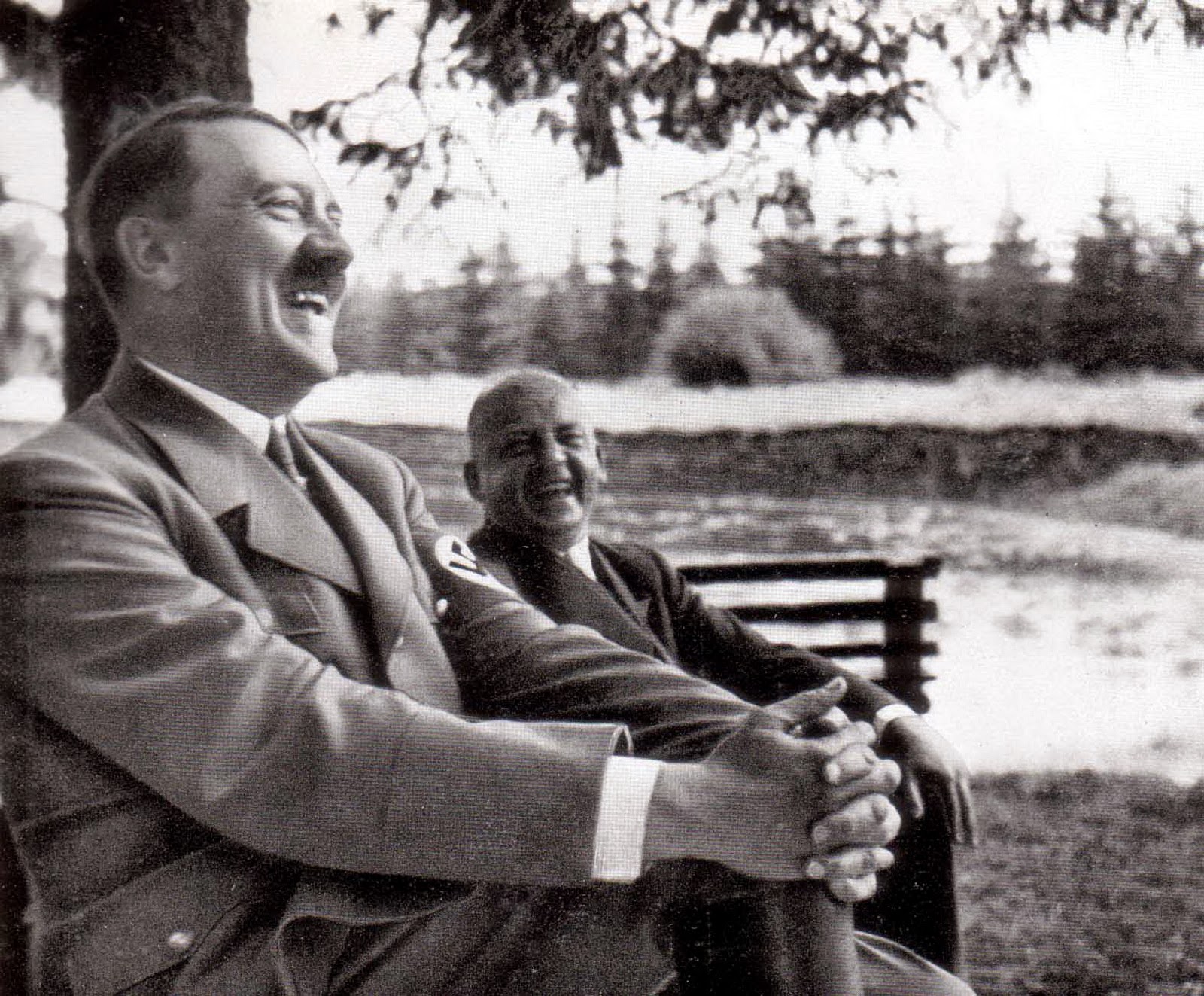
Adolf Hitler Laughing at a Vacation in Harz Mountains


Image size: 1600 x 1323 pixel. 733 KB
Date: 17-21 July 1935
Place: Harz mountains, Germany
Photographer: Heinrich Hoffmann

Original postcard caption "Eine lustige Erholungsstunde während der Fahrt" (A funny recreation hour in motion). Adolf Hitler (Führer und Reichskanzler) sitting on a bench and laughing while listening to a humorous accordeon plays performed by Arthur Kannenberg, Hitler's chief butler (Küchenchef). This picture was taken by Hitler personal photographer, Heinrich Hoffmann, during a trip to the Harz mountains (Northern Germany), 17-21 July 1935. The man sitting with Hitler (and also laughing with him) is Adolf Wagner (Gauleiter München-Oberbayern). The Führer was said to be particularly fond of a couple jokes and told the best ones over and over. One joke that Hitler liked to tell was at the expense of his pompous Luftwaffe chief Hermann Göring, a man forever designing himself new uniforms and giving himself new orders and decorations. “One day,“ Hitler used to say, “Mrs. Göring came into the bedchamber and found her husband waving his Field Marshall‘s baton over his underwear. 'Hermann, darling, what are you doing?‘ she enquired. Göring answered, 'I am promoting my underpants to overpants!'"

Source:
http://collections.yadvashem.org/photosarchive/en-us/62360.html
http://www.dailymail.co.uk/news/article-1028813/Hitler-comedian-The-Nazi-leaders-bodyguard-reveals-different-dictator.html
http://elektra.bsb-muenchen.de/jsp/frames/documentframe.jsp;jsessionid=6A326AED71185862B8D368590DD77E36?database=BILDARC@BSBBild$1&position=1&timeout=10
http://www.germanpostalhistory.com/php/viewitem.php?itemid=52733&germany%20cover=search&#littlepic0


03 December 2012

Member of 250. Infanterie-Division (División Azul)


Image size: 1422 x 1600 pixel. 619 KB
Date: 1941
Place: Unknown
Photographer: Unknown

Spanish member of 1.Bataillon/Infanterie-Regiment 263/250.Infanterie-Division. Men from this division were called "Blue Division" (División Azul) because of the blue Falangist shirt they wearing in the siege of Leningrad. The fahnenträger (flag holder) is wearing gasplane (gas mask bag), MP40 ammo pouch, and stahlhelm with Wehrmacht/Spanish flag decals. Also he is holding the banner of his batallion. Note the Spanish award on their uniform! The red one is the "Cruz al Mérito Militar con Distintivo Rojo"; the yellow one is the "Medalla de Mutilado de Guerra por la Patria". The formation of what would become 250. Infanterie-Division (División Azul) was first suggested by Serrano Súñer, foreign minister and the most trusted advisor of the Spanish dictator Francisco Franco, following the German invasion of the USSR 1941 as an alternative to a declaration of war. Recruitment of volunteers began 28 June and a large number of members of the fascist Falange (the full name of the party was Falange Española Tradicionalista y de las J.O.N.S (FET)) volunteered, including six members of the FET National Council and several provisional governors. The Spanish Army however insisted on keeping control of the unit rather than have it run by the FET and in the end all the officers came from the regular army as well as about 70% of the volunteers, most of them veterans of the Spanish Civil War. The commander of the unit would be Agustín Muñoz Grandes, former secretary general of the FET and one of the few Falangist generals. The unit was technically subordinate to the Spanish Ministry of the Army but served under German command. The first volunteers left for Germany 17 July for further training and remained in Grafenwöhr for training until being sent to the Eastern Front Aug 1941. They saw their first action 12 Oct 1941 at Lake Ilmen and remained on the front near Leningrad until it was disbanded Oct 1943, most famous and costly battle being Krasny Bor during Operation Polar Star.

Source:
http://www.axishistory.com/index.php?id=3849