Showing posts with label adolf hitler. Show all posts

24 March 2026

Visit of Hitler to Heeresgruppe Weichsel (1945)


Image size: 1232 x 848 pixel. 297 KB
Date: Sunday, 11 March 1945
Place: Schloss Freienwalde, Bad Freienwalde, Oder (Germany)
Photographer: Walter Frentz

This photo was taken on 11 March 1945 when Adolf Hitler (Führer und Oberster Befehlshaber der Wehrmacht) inspected the Heeresgruppe Weichsel, and it is recorded as the Hitler's last visit to the front! He departed for Bad Freienwalde on the Oder. In a meeting with the commander of the 9th Army, Theodor Busse, the Führer emphasized to his officers to hold back the Russian troops across the Oder River for as long as possible until his latest ultimate weapon was ready (although Hitler himself did not specify what that weapon was!). For identification in this photo, standing around Hitler from left to right: General der Artillerie Wilhelm Berlin (General der Artillerie im Oberkommando des Heeres und Kommandierender General CI. Armeekorps), Generaloberst Robert Ritter von Greim (Chef Luftflotte 6), Generalmajor Franz Reuß (Kommandeur 4. Flieger-Division), General der Flakartillerie Job Odebrecht (Kommandierender General II. Flakkorps), and General der Infanterie Theodor Busse (Oberbefehlshaber 9. Armee).

On March 11, 1945, as the noose of the Soviet Red Army tightened around the remnants of Nazi Germany’s Eastern Front defenses, Adolf Hitler undertook what would become his final journey away from the Reich Chancellery in Berlin to visit the forward command elements of Heeresgruppe Weichsel, the army group hastily formed to shield the approaches to the German capital. The destination was Schloss Freienwalde, a stately palace in the town of Bad Freienwalde along the Oder River, roughly sixty kilometers northeast of Berlin and serving as a discreet headquarters for units of the Ninth Army. This excursion, conducted under conditions of strict secrecy and by motorcade rather than aircraft to minimize exposure to Soviet air reconnaissance, represented a last personal effort by the Führer to rally his commanders, assess the collapsing Oder line, and project unyielding resolve in the face of imminent catastrophe. The meeting, preserved in a now-restored historical photograph depicting Hitler seated at a table strewn with operational maps while surrounded by his senior officers, captured a moment of desperate strategic deliberation amid the final weeks of the Third Reich.

The broader military context for this visit was one of unrelenting disaster for German forces. Following the devastating Soviet Vistula-Oder Offensive launched in January 1945, which had swept through Poland and driven the Wehrmacht back across the Oder River in a matter of weeks, Hitler had ordered the creation of Heeresgruppe Weichsel on January 24 as a new formation to consolidate the northern sector of the Eastern Front. Command was entrusted not to a seasoned professional soldier but to Heinrich Himmler, the Reichsführer-SS, reflecting Hitler’s growing preference for ideological loyalists over traditional generals and his belief that fanaticism could compensate for material shortages. By early March, however, the army group—comprising the Third Panzer Army, Ninth Army, and Eleventh Army along with various ad-hoc formations—was stretched to the breaking point. Manpower was critically depleted, with divisions often reduced to regimental strength; ammunition, fuel, and heavy weapons were in short supply; and Soviet bridgeheads across the Oder, particularly around Küstrin, threatened to erupt into a full-scale breakthrough toward Berlin at any moment. Just one day after Hitler’s visit, on March 12, Soviet forces of the 1st Belorussian Front under Marshal Georgy Zhukov would capture Küstrin, further exposing the fragility of the German positions. The Ninth Army, commanded by General der Infanterie Theodor Busse, bore the brunt of the central sector’s defense, facing overwhelming Soviet artillery barrages and armored superiority while attempting to fortify makeshift lines with whatever reserves could be scraped together from retreating units and Volkssturm militias.

Hitler’s motorcade departed Berlin in the morning of March 11, traveling along roads that had been cleared of unnecessary traffic and placed under heightened security to prevent any disruption or intelligence leaks. Upon arrival at Schloss Freienwalde, he was greeted by a small but select group of commanders who had been summoned for the situation conference. Prominent among them were General Theodor Busse, whose Ninth Army headquarters elements hosted the meeting; Generaloberst Robert Ritter von Greim, the highly decorated Luftwaffe officer who would soon be appointed the last Commander-in-Chief of the Luftwaffe; Generalmajor Franz Reuss, commanding the 4th Flieger Division responsible for air support operations; and General Job Odebrecht, another Luftwaffe general involved in coordinating flak and fighter assets for the Oder front. The officers stood clustered around large-scale maps spread across a table in one of the palace’s rooms, their uniforms bearing the Iron Crosses, Knight’s Crosses, and other decorations earned through years of brutal combat, while Hitler, dressed in his plain field-gray tunic with black trousers and polished boots, leaned forward in his chair to examine the dispositions. The photograph of this scene, originally grainy and faded from wartime processing, now appears in crystal-clear 4K detail after restoration, revealing every facial expression, the texture of the wool uniforms, the gleam of medals, and the intricate lines on the maps with the sharpness of a modern professional DSLR capture.

According to accounts of the conference, Busse opened with a candid briefing on the tactical realities confronting Heeresgruppe Weichsel. He detailed the Soviet concentrations opposite the Ninth Army, the exhaustion of German troops after months of continuous withdrawal and counterattacks, the critical lack of armored reserves following transfers to other sectors, and the devastating impact of Red Army artillery that could deliver thousands of shells per kilometer of front. Von Greim and the other Luftwaffe officers contributed assessments of available air assets, noting that fuel shortages and Allied bombing had reduced the once-mighty Luftwaffe to sporadic sorties by jet prototypes and night fighters, with little prospect of sustained close air support. Hitler listened intently, his left hand trembling noticeably from the effects of Parkinson’s disease and the cumulative strain of the war, yet he maintained a composed demeanor. In response, he delivered a characteristically fervent monologue, insisting that the Oder line must be held at all costs. He spoke of imminent “wonder weapons” that would soon enter mass production and deployment—vague references to advanced jet aircraft like the Me 262, improved V-2 rockets, or even rumored experimental technologies—claiming they would inflict catastrophic losses on the Soviets and allow Germany to regain the initiative. He deliberately withheld specifics, perhaps to preserve morale or because the projects themselves were still mired in delays and resource shortages. The generals, aware of the growing disconnect between Hitler’s optimism and the battlefield facts, nonetheless responded with formal assurances of loyalty and determination, a reflection of the atmosphere of obedience that still prevailed even as defeat loomed.

The conference extended for several hours, blending operational discussion with Hitler’s broader strategic exhortations about the need to tie down Soviet forces and buy time for reinforcements or political developments on the Western Front. No major new directives emerged from the meeting; instead, it served primarily as a morale-boosting exercise and a means for Hitler to demonstrate his personal engagement with the troops. By afternoon, the entourage returned to Berlin via the same cautious route, with Hitler retreating once more into the protective confines of the Führerbunker. This journey marked the absolute end of his frontline visits; never again would he leave the capital or directly inspect his armies in the field. Within days, the pressure on Heeresgruppe Weichsel escalated dramatically. Himmler, whose command had proven ineffective amid his own health problems and lack of military expertise, was relieved on March 20 and replaced by Generaloberst Gotthard Heinrici, a more pragmatic defender who would orchestrate the final, futile stand along the Oder and Seelow Heights. The Soviet Berlin Offensive, launched in mid-April, would shatter these defenses, leading to the encirclement of Berlin and the regime’s collapse.

The restored photograph from the Schloss Freienwalde conference stands today as one of the most evocative images of the war’s closing phase. It shows Hitler in profile, his mustache and slicked hair sharply defined, gazing toward the maps while Busse and the Luftwaffe generals lean in attentively, their faces etched with the fatigue and gravity of men who understood the odds. The lighting and contrast have been balanced to modern standards, eliminating every trace of dust, scratches, and chemical degradation from the original print, yet the historical authenticity remains untouched—no expressions altered, no proportions changed. It is as though the moment was photographed yesterday with contemporary equipment, yet it still depicts the exact individuals, poses, and tense atmosphere of that March day in 1945.

This photo was taken on 11 March 1945 when Adolf Hitler (Führer und Oberster Befehlshaber der Wehrmacht) inspected the Heeresgruppe Weichsel, and it is recorded as the Hitler's last visit to the front! He departed for Bad Freienwalde on the Oder. In a meeting with the commander of the 9th Army, Theodor Busse, the Führer emphasized to his officers to hold back the Russian troops across the Oder River for as long as possible until his latest ultimate weapon was ready (although Hitler himself did not specify what that weapon was!). For identification in this photo, standing around Hitler from left to right: General der Artillerie Wilhelm Berlin (General der Artillerie im Oberkommando des Heeres und Kommandierender General CI. Armeekorps), Generaloberst Robert Ritter von Greim (Chef Luftflotte 6), Generalmajor Franz Reuß (Kommandeur 4. Flieger-Division), General der Flakartillerie Job Odebrecht (Kommandierender General II. Flakkorps), and General der Infanterie Theodor Busse (Oberbefehlshaber 9. Armee).


This photo was taken on 11 March 1945 when Adolf Hitler (Führer und Oberster Befehlshaber der Wehrmacht) inspected the Heeresgruppe Weichsel, and it is recorded as the Hitler's last visit to the front! He departed for Bad Freienwalde on the Oder. In a meeting with the commander of the 9th Army, Theodor Busse, the Führer emphasized to his officers to hold back the Russian troops across the Oder River for as long as possible until his latest ultimate weapon was ready (although Hitler himself did not specify what that weapon was!). For identification in this photo, standing around Hitler from left to right: Generaloberst Robert Ritter von Greim (Chef Luftflotte 6), Generalmajor Franz Reuß (Kommandeur 4. Flieger-Division), General der Flakartillerie Job Odebrecht (Kommandierender General II. Flakkorps), and General der Infanterie Theodor Busse (Oberbefehlshaber 9. Armee).


Source :
https://alifrafikkhan.blogspot.com/2014/08/foto-adolf-hitler-di-tahun-1945.html
https://en.wikipedia.org/wiki/Army_Group_Vistula

28 February 2026

Adolf Hitler and Ion Antonescu at the Schloss Kleßheim (1943)


Image size: 1248 x 832 pixel. 268 KB
Date: Monday, 12 April 1943
Place: Schloss Kleßheim, Salzburg, Austria
Photographer: Walter Frentz

This picture was taken by Walter Frentz at the Schloss Kleßheim in Salzburg, 12 April 1943. From left to right: Otto Meißner (Leiter der Präsidialkanzlei), Generalleutnant Walter Warlimont (Stellvertretender Chef des Wehrmachtführungsstabes), Paul Otto Schmidt (interpreter), Marshal Ion Antonescu (Romanian dictator and Prime Minister), unknown Romanian official, Adolf Hitler (Führer und Oberster Befehlshaber der Wehrmacht), and Generalfeldmarschall Wilhelm Keitel (Chef der Oberkommando der Wehrmacht).

By April 1943, World War II had reached a turning point on the Eastern Front following the devastating German defeat at Stalingrad earlier that year. Romania, under Marshal Ion Antonescu's authoritarian rule since 1940, remained a vital Axis ally, supplying troops, oil, and resources to Nazi Germany. However, mounting losses and the advancing Soviet forces strained the partnership. Antonescu sought reassurances from Adolf Hitler regarding Romania's territorial integrity, particularly the return of Northern Transylvania, ceded to Hungary via the 1940 Vienna Award. Hitler, facing wavering commitment from his satellites, convened a series of bilateral summits at Schloss Klessheim, a Baroque palace near Salzburg, Austria, renovated in 1940 as a luxurious guest house for diplomatic receptions. The palace, originally built in the 18th century by Prince-Archbishop Firmian, featured opulent halls, gardens, and conference rooms equipped for high-level discussions, including strategic planning with maps.

These meetings included Italian leader Benito Mussolini, Romanian Marshal Ion Antonescu, and Hungarian Regent Miklós Horthy, each held separately to bolster Axis unity. For Antonescu, the visit on April 12-13, 1943, was an opportunity to address military cooperation, economic strains, and the sensitive "Jewish question," where Germany pressured Romania to accelerate deportations as part of the Final Solution. Despite earlier alignments, Antonescu resisted full compliance, prioritizing Romanian sovereignty.

Marshal Ion Antonescu arrived at Schloss Klessheim on April 12, 1943, amid a backdrop of spring landscapes and heightened security. The palace, serving as a neutral yet grandiose venue for Axis diplomacy, was guarded by SS personnel and equipped with anti-aircraft defenses. Hitler personally welcomed Antonescu, a gesture reflecting the Romanian leader's importance as a key supplier of oil and manpower. Accompanied by German Foreign Minister Joachim von Ribbentrop and other officials, the two leaders exchanged formal salutes and handshakes before proceeding to the palace's interior. Newsreel footage and photographs captured the arrival, emphasizing the ceremonial aspects of the visit.

The two-day summit included private discussions and formal receptions, with Antonescu's delegation including advisors focused on military and economic matters. The atmosphere was tense, as both sides grappled with the war's deteriorating outlook.

The centerpiece of the visit was a strategic conference held in one of Schloss Klessheim's equipped rooms, where Hitler and Antonescu reviewed military maps spread across a large table. Joined by high-ranking officers such as Field Marshal Wilhelm Keitel and Walter Warlimont, the leaders discussed the Eastern Front's challenges, Romania's ongoing contributions, and future operations. Hitler urged Antonescu to maintain commitment despite recent setbacks, criticizing other allies for insufficient effort while praising Romania's role.

A significant portion of the talks addressed the "Jewish question." Germany intensified pressure on Antonescu to deport Romanian Jews to extermination camps in occupied Poland, following earlier plans discussed in 1942. Antonescu, aware of the deportations' lethal implications, resisted, citing Romania's independent approach and refusing to yield without concessions like the return of Northern Transylvania. The discussions also touched on economic cooperation, with Romania's oil fields critical to the German war machine, and territorial assurances against Hungarian and Bulgarian claims.

The map room setting allowed for detailed examination of frontline positions, supply lines, and potential counteroffensives, underscoring the military dimension of the alliance. Follow-up talks on April 14 involved Ribbentrop and Mihai Antonescu, Romania's Foreign Minister, further emphasizing resistance to German demands on deportations.

The April 1943 summit at Schloss Klessheim highlighted the fragility of the Axis coalition. While Hitler sought to rally his allies, Antonescu's visit revealed growing Romanian disillusionment with the war. Antonescu secured no firm commitments on Transylvania but maintained Romania's autonomy on internal policies, notably halting Jewish deportations from core territories. This resistance marked a divergence from full Nazi compliance, influenced by shifting war fortunes.

In the ensuing months, Romania's position worsened, leading to secret overtures to the Allies. By August 1944, King Michael orchestrated a coup, arresting Antonescu and switching sides to the Allies. Antonescu was tried and executed in 1946 for war crimes. Schloss Klessheim, once a hub of Axis diplomacy, now houses a casino and serves as a reminder of wartime intrigue. The meeting exemplifies the personal dynamics between Hitler and his allies, blending strategy, ideology, and pragmatism in the face of impending defeat.


Source:
https://www.walter-frentz-collection.de/fotoarchiv/personenarchiv-a-z/personen-a-b/

Adolf Hitler and Ion Antonescu at the Führerhauptquartier Wolfsschanze (1942)


Image size: 1248 x 832 pixel. 284 KB
Date: Wednesday, 11 February 1942
Place: Führerhauptquartier Wolffschanze, Rastenburg, East Prussia
Photographer: Walter Frentz

This picture was taken by Walter Frentz at the Führerhauptquartier Wolffschanze, 11 February 1942. From left to right: General der Artillerie Alfred Jodl (Chef des Wehrmachtsführungsamtes), Marshal Ion Antonescu (Romanian dictator and Prime Minister), Paul Otto Schmidt (interpreter), Adolf Hitler (Führer und Oberster Befehlshaber der Wehrmacht), Generalfeldmarschall Wilhelm Keitel (Chef der Oberkommando der Wehrmacht), Major Eckhard Christian (persönlicher Luftwaffen Generalstabsoffizier des Chef Oberkommando der Wehrmacht), and Generaloberst Franz Halder (Chef des Generalstabes des Heeres).

In the midst of World War II, Romania under the leadership of Marshal Ion Antonescu was a key ally of Nazi Germany. Having joined the Axis powers through the Tripartite Pact in November 1940, Romania contributed significantly to the Eastern Front campaign against the Soviet Union, providing the third-largest Axis army. By early 1942, the war effort was intensifying, with Operation Barbarossa facing harsh winter conditions and logistical challenges. Antonescu's visit to Adolf Hitler's eastern headquarters, the Führerhauptquartier Wolfsschanze (Wolf's Lair), located in the dense forests near Rastenburg in East Prussia (now Kętrzyn, Poland), was a critical diplomatic and strategic engagement. This fortified complex, built in 1940-1941, served as Hitler's primary command center for directing operations on the Eastern Front. The visit on February 11, 1942, aimed to strengthen coordination between the two nations, discuss military contributions, and address territorial concerns involving Romania's neighbors.

The Wolfsschanze was a sprawling, heavily secured site encompassing over 6.5 square kilometers, divided into three security zones. It included bunkers, barracks, a power station, and specialized facilities like a map room for strategic planning and a radio communication center for maintaining contact with field units. The headquarters housed up to 2,000 personnel at its peak, reflecting its role as the nerve center of German operations.

On the morning of February 11, 1942, amid falling snow and frigid temperatures, Marshal Ion Antonescu arrived by train at the nearby Görlitz station. Hitler personally greeted him on the platform, a gesture underscoring the importance Germany placed on the Romanian alliance. Snow blanketed the ground, and the two leaders exchanged salutes before proceeding in a car to the main complex. Accompanied by high-ranking German officials, including General Alfred Jodl, Chief of the Operations Staff of the Armed Forces High Command, they drove through the forested paths to the inner security zone (Sperrkreis 1). This arrival was captured in newsreel footage, highlighting the ceremonial aspects of the visit amid the harsh winter landscape.

Upon entering the headquarters, Antonescu was welcomed by additional officers, setting the stage for substantive discussions. The Wolfsschanze's design emphasized security and functionality, with reinforced concrete bunkers camouflaged to blend into the surroundings. Hitler's personal bunker, along with guest accommodations, ensured that high-level visitors like Antonescu could engage in confidential talks without interruption.

The core of the visit was a strategic meeting held in the map room, a central facility within the Wolfsschanze equipped with large tables covered in detailed military maps and walls adorned with operational charts. Here, Hitler and Antonescu, joined by key advisors such as Foreign Minister Joachim von Ribbentrop and Field Marshal Wilhelm Keitel, reviewed the ongoing war effort. The discussions focused on political and military issues, including Romania's contributions to the Eastern Front and economic cooperation.

A significant outcome was Hitler's personal assurance to Antonescu that Germany would guarantee Romania's territorial integrity post-war, specifically preventing any aggressive actions by Hungary and Bulgaria against Romania. The leaders also critiqued the perceived inadequate war efforts of these two nations, emphasizing Romania's more substantial role. These talks were crucial for Antonescu, who sought to safeguard Romania's interests amid shifting alliances and border disputes, particularly regarding Transylvania. The map room, often used for daily situation briefings (Lagebesprechungen), provided the perfect setting for poring over frontline positions and planning future operations.

As part of the visit, Antonescu was given a tour of the Wolfsschanze's key operational areas to demonstrate German military efficiency and foster closer collaboration. This included an inspection of the radio communication room, a vital component of the headquarters' infrastructure. The communication center, equipped with advanced radio equipment and telegraph lines, was essential for relaying orders to distant fronts and maintaining real-time coordination with Axis forces. Antonescu's inspection highlighted the technological prowess of the German command system, allowing him to observe how Hitler maintained control over vast theaters of war. While specific details of this inspection are sparse in surviving records, such tours were common for high-profile allies to build trust and share insights into operational capabilities. The facility underscored the Wolfsschanze's role as a hub for encrypted communications, ensuring secure links with Berlin and field commanders.

The tour also likely encompassed other elements of the complex, such as the power generation bunkers and anti-aircraft defenses, emphasizing the site's self-sufficiency and defensive fortifications.

Antonescu's visit to the Wolfsschanze on February 11, 1942, reinforced the Axis partnership at a pivotal moment when the Eastern Front was bogged down in winter stalemates. It boosted Romanian morale and commitment to the war, while providing Antonescu with reassurances on territorial matters. However, as the war turned against the Axis, these alliances frayed; Romania would switch sides in August 1944, leading to Antonescu's arrest and execution in 1946.

This meeting exemplifies the personal diplomacy between Hitler and his allies, conducted in the secretive confines of the Wolfsschanze. Despite the site's eventual abandonment and destruction in 1945, it remains a symbol of Nazi wartime strategy, now preserved as a historical site open to the public.


Inspection to the communication room. The two generals at left is Generaloberst Franz Halder (Chef des Generalstabes des Heeres) and General der Nachrichtentruppe Erich Fellgiebel (Chef des Wehrmachtnachrichten-Verbindungswesen).


Source :
https://grokipedia.com/
https://www.walter-frentz-collection.de/fotoarchiv/personenarchiv-a-z/personen-a-b/

04 September 2021

Hitler Arrived in an Airfield in Poland


Image size: 2048 x 1339 pixel. 1 MB
Date: Monday, 25 September 1939
Place: Alexandrow Airfield, between Bzura and the Vistula River, Poland
Photographer: Kriegsberichter Falk of Propaganda-Kompanie 367 (Ost)

On 25 September 1939, Adolf Hitler flew from Zoppot to the area around Warsaw, Poland. He made visits to the 8. Armee (General der Infanterie Johannes Blaskowitz) and 10. Armee (General der Artillerie Walther von Reichenau), as well as the German army headquarters in Grodjisk Mazowieki. After that he returned to Godentow-Lanz by airplane. The next day (26 September 1939 at 09:30 am), Hitler returned to Berlin boarding the Führersonderzug "Amerika". He arrived in the German capital at 17:05 in the afternoon. The Führer only returned to Poland again on 5 October 1939 to take part in the German victory parade. This photo was taken by Kriegsberichter Falk from Propaganda-Kompanie 367 (Ost) on 25 September 1939 in the area of 10. Armee, which located between Bzura and the Vistula River (facing west of Warsaw), and shows the moment Hitler had just arrived at the nearest airfield at Alexandrow. For the identification, front row from left to right: General der Artillerie Franz Halder (Chef des Generalstabes des Heeres), Reichsleiter Martin Bormann (Persönlicher Sekretär bzw. Stabsleiter des Stellvertreters des Führers Rudolf Hess), Generaloberst Gerd von Rundstedt (Oberbefehlshaber Heeresgruppe Süd), Generaloberst Walther von Brauchitsch (Oberbefehlshaber des Heeres), Generaloberst Wilhelm Keitel (Chef Oberkommando der Wehrmacht), Adolf Hitler (Führer und Oberster Befehlshaber der Wehrmacht), Generalmajor Erwin Rommel (Kommandeur Führer-Begleit-Bataillon), General der Artillerie Walther von Reichenau (Oberbefehlshaber 10. Armee), Generalmajor Friedrich Paulus (Chef des Generalstabes 10. Armee), and SS-Gruppenführer Karl Wolff (Verbindungsoffizier zwischen dem Reichsführer-SS und dem Führerhauptquartier).


Source :
Bundesarchiv Bild 101I-013-0060-20
http://alifrafikkhan.blogspot.com/2016/09/kunjungan-adolf-hitler-ke-front.html

01 January 2021

Germany's Heroes Remembrance Day 1940


Image size: 2048 x 1370 pixel. 457 KB
Date: Sunday, 10 March 1940
Place: Unter den Linden, Berlin, Germany
Photographer: Unknown

Heldengedenktag (Heroes Remembrance Day) 1940 on Unter den Linden boulevard in Berlin. Reich Chancellor Adolf Hitler, accompanied by Reich Marshal Hermann Göring, Grand Admiral Erich Raeder and Reichsführer-SS Heinrich Himmler, greets the honor battalion of the Wehrmacht marching past. March 10, 1940. In 1919, the German War Graves Commission (Volksbund Deutsche Kriegsgräberfürsorge) proposed a Volkstrauertag (people's day of mourning) for German soldiers killed in the First World War. It was first held in 1922 in the Reichstag. In 1926, Volkstrauertag became a feature on what Catholics considered Reminiscere (the second Sunday of Lent.). On 27 February 1934, the National Socialists introduced national holiday legislation to create Heldengedenktag ("Day of Commemoration of Heroes"), cementing the observance. In the process, they completely changed the character of the holiday: the emphasis shifted to hero worship rather than remembering the dead. Furthermore, five years later the Nazis abolished Buß- und Bettag as a non-working day and moved its commemoration to the following Sunday, to further the war effort. Joseph Goebbels as Propaganda Minister, issued guidelines on content and implementation, instructing that flags no longer be flown at half-mast. The last Heldengedenktag was celebrated in 1945. Photo by Popperfoto.


Source :
https://en.wikipedia.org/wiki/Volkstrauertag
https://www.facebook.com/photo/?fbid=412210326714464&set=gm.1641608349357915

03 December 2014

Adolf Hitler on his Release from Landsberg Prison


Image size: 1600 x 982 pixel. 550 KB
Date: Saturday, 20 December 1924
Place: Landsberg Prison, Landsberg am Lech, Bavaria, Germany
Photographer: Heinrich Hoffmann

Adolf Hitler, age 35, wearing trench coat posed beside a gray Marcedes-Benz 11/40 (model number RIO 4346) on his release from Landsberg Prison, on December 20, 1924, after serving only nine months. He had been charged and convicted for high treason for attempting to seize power in Germany in the failed Munich Putsch coup the previous year. He spent 264 days behind bars in total. It was in this period that Hitler wrote the book that would become the literary backbone to Nazi ideology: "Mein Kampf", or "My Struggle". It was written with the help of Rudolf Hess, his deputy, who had also been involved in the Putsch and sent to prison. A combination of Hitler’s personal story and political ideology, Mein Kampf set out Hitler’s vision for Germany’s future, including the extermination of the Jewish people. Eventually ran to two volumes. A Landsberg prison official reportedly said Hitler hoped the profits from the tract would enable him “to fulfill his financial obligations and to defray the expenses incurred at the time of his trial”. Eight years later, Hitler would be sworn in as Chancellor of Germany, in 1933.


Source:
http://www.hermann-historica.de/auktion/hhm63.pl?db=kat63_r.txt&f=ZAEHLER&c=64&t=temartic_R_D&co=1
http://www.theatlantic.com/infocus/2011/06/world-war-ii-before-the-war/100089/

02 December 2014

Adolf Hitler Laughing at a Vacation in Harz Mountains


Image size: 1600 x 1323 pixel. 733 KB
Date: 17-21 July 1935
Place: Harz mountains, Germany
Photographer: Heinrich Hoffmann

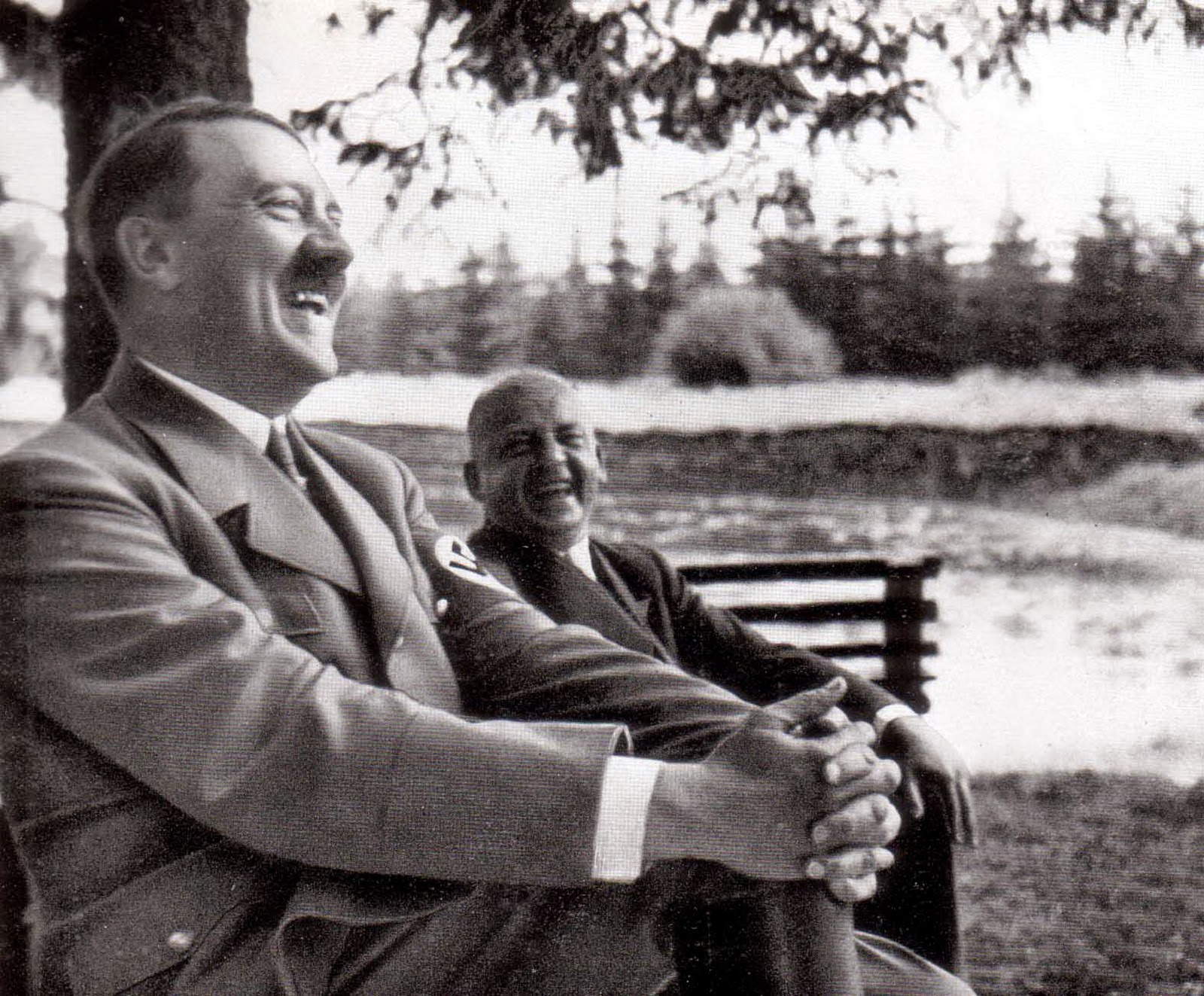
Original postcard caption "Eine lustige Erholungsstunde während der Fahrt" (A funny recreation hour in motion). Adolf Hitler (Führer und Reichskanzler) sitting on a bench and laughing while listening to a humorous accordeon plays performed by Arthur Kannenberg, Hitler's chief butler (Küchenchef). This picture was taken by Hitler personal photographer, Heinrich Hoffmann, during a trip to the Harz mountains (Northern Germany), 17-21 July 1935. The man sitting with Hitler (and also laughing with him) is Adolf Wagner (Gauleiter München-Oberbayern). The Führer was said to be particularly fond of a couple jokes and told the best ones over and over. One joke that Hitler liked to tell was at the expense of his pompous Luftwaffe chief Hermann Göring, a man forever designing himself new uniforms and giving himself new orders and decorations. “One day,“ Hitler used to say, “Mrs. Göring came into the bedchamber and found her husband waving his Field Marshall‘s baton over his underwear. 'Hermann, darling, what are you doing?‘ she enquired. Göring answered, 'I am promoting my underpants to overpants!'"

Source:
http://collections.yadvashem.org/photosarchive/en-us/62360.html
http://www.dailymail.co.uk/news/article-1028813/Hitler-comedian-The-Nazi-leaders-bodyguard-reveals-different-dictator.html
http://elektra.bsb-muenchen.de/jsp/frames/documentframe.jsp;jsessionid=6A326AED71185862B8D368590DD77E36?database=BILDARC@BSBBild$1&position=1&timeout=10
http://www.germanpostalhistory.com/php/viewitem.php?itemid=52733&germany%20cover=search&#littlepic0


19 November 2014

Adolf Hitler Inspecting Gustav


Image size: 1600 x 1233 pixel. 601 KB
Date: Sunday, 4 April 1943
Place: Reichswerke Hermann Göring, Linz, Germany
Photographer: Walter Frentz

This picture was taken by Walter Frentz in 4 April 1943 at Reichswerke Hermann Göring, Linz (Germany), when Hitler visited the Eisenbahngeschütz 80 cm Kanone Schwerer Gustav. FLTR: Generalleutnant Walter Buhle (Chef vom Heeresstab im Oberkommando der Wehrmacht), Ingenieur Erich Müller (Wehrwirtschaftsführer), Generalfeldmarschall Wilhelm Keitel (Chef des Oberkommando der Wehrmacht), Reichsleiter Martin Bormann (Stabsleiter im Amt des Stellvertreters des Führers), Adolf Hitler (Führer und Reichskanzler), Prof.Dr.-Ing.Albert Speer (Reichsminister für Rüstung und Kriegsproduktion), and SS-Gruppenführer Julius Schaub (not visible in this picture, Chefadjutant des Führers Adolf Hitler). Schwerer Gustav (Heavy Gustaf or Great Gustaf) was the name of a German 80 cm K (E) railway gun. It was developed in the late 1930s by Krupp as siege artillery for the explicit purpose of destroying the main forts of the French Maginot Line, the strongest fortifications then in existence. The fully assembled gun weighed nearly 1,350 tonnes, and could fire shells weighing seven tonnes to a range of 47 kilometres (29 mi). The gun was designed in preparation for the Battle of France, but was not ready for action when the battle began, and in any case the Wehrmacht's Blitzkrieg offensive through Belgium rapidly outflanked and isolated the Maginot Line's World War I-era static defenses, forcing them to surrender uneventfully and making their destruction unnecessary. Gustav was later employed in the Soviet Union at the siege of Sevastopol during Operation Barbarossa, where among other things, it destroyed a munitions depot buried in the bedrock under a bay. The gun was moved to Leningrad, and may have been intended to be used in the Warsaw Uprising like other German heavy siege pieces, but the rebellion was crushed before it could be prepared to fire. Gustav was destroyed near the end of the war in 1945 to avoid capture by the Red Army. It was the largest-calibre rifled weapon ever used in combat, the heaviest mobile artillery piece ever built in terms of overall weight, and fired the heaviest shells of any artillery piece. It is only surpassed in calibre by the British Mallet's Mortar and the American Little David mortar (both 36 inch; 914 mm).


Source:
http://elektra.bsb-muenchen.de/servlet/Top/frames/hitsframe#bildarc
http://en.wikipedia.org/wiki/Schwerer_Gustav

18 November 2014

Adolf Hitler Inspecting Dora


Image size: 1600 x 1133 pixel. 387 KB
Date: Friday, 19 March 1943
Place: Rügenwalde, Pomerania, Germany
Photographer: Walter Frentz

On 18-19 March 1943 Hitler visited the town of Rügenwalde/Pomerania (Germany) to see the 80 cm. Eisenbahngeschütz "Dora", the largest gun in the world. While Hitler was there the gun fired two granates. This picture was taken in 19 March 1943 by Walter Frentz and shows, from left to right: General der Artillerie Alfred Jodl (Chef Wehrmacht-Führungsamt), SS-Oberführer Prof. Dr.-Ing. e.h. mult. Ferdinand Porsche (Vorsitzender der Panzerkommission), Generaloberst Heinz Guderian (Generalinspekteur der Panzertruppen), Generalleutnant Walter Buhle (Chef vom Heeresstab im Oberkommando der Wehrmacht), Adolf Hitler (Führer und Reichskanzler), Generalfeldmarschall Wilhelm Keitel (Chef des Oberkommando der Wehrmacht), Hauptdienstleiter Dipl.-Ing. Karl-Otto Saur (Staatssekretär im Reichsministerium für Rüstung und Kriegsproduktion), and SS-Gruppenführer Julius Schaub (Chefadjutant des Führers Adolf Hitler). Dora was the second giant railway gun to be produced by Germany. It was deployed briefly against Stalingrad, where the gun arrived at its emplacement 15 kilometers (9.3 mi) to the west of the city sometime in mid-August 1942. It was ready to fire on 13 September. It was quickly withdrawn when Soviet encirclement threatened. When the Germans began their long retreat they took Dora with them. Dora was broken up before the end of the war, being discovered in the west by American troops some time after the discovery of Schwerer Gustav.


Source:
http://rarehistoricalphotos.com/heavy-gustav-hitler-generals-inspecting-largest-caliber-rifled-weapon-ever-used-combat/

16 November 2014

Sepp Dietrich Receiving Brillanten from Hitler


Image size: 1600 x 1065 pixel. 462 KB
Date: Thursday, 10 August 1944
Place: Führerhauptquartier Wolfsschanze, Rastenburg, Ostpreußen/East Prussia (Germany)
Photographer: Unknown photographer from Heinrich Hoffmann firm

Presentation of the Ritterkreuz des Eisernen Kreuzes mit Eichenlaub, Schwerter und Brillanten #16 (Knight's Cross of the Iron Cross with Oakleaves, Swords and Diamonds) to SS-Oberstgruppenführer und Panzer-Generaloberst der Waffen-SS Josef "Sepp" Dietrich (Oberbefehlshaber 5. Panzerarmee) by Adolf Hitler (Führer und Reichskanzler). Dietrich already received the formal confirmation from 6 August 1944, and he got this highest bravery medal Germany could ever give for his performances at the Battle of Normandy as Kommandierender General I. SS-Panzerkorps. This picture was taken by one of the photographer from Heinrich Hoffmann firm in 10 August 1944 at Führerhauptquartier Wolfsschanze (Rastenburg). In the background are SS-Gruppenführer und Generalleutnant der Waffen-SS Hermann Fegelein (blocked, Verbindungsoffizier der Waffen-SS zum Führerhauptquartier) and SS-Hauptsturmführer Otto Günsche (Persönlicher Adjutant Adolf Hitler).


Source:
Book "Fotos aus dem Führerhauptquartier" from Hermann Historica München

Sepp Dietrich Received by Hitler


Image size: 1600 x 1060 pixel. 519 KB
Date: Thursday, 10 August 1944
Place: Führerhauptquartier Wolfsschanze, Rastenburg, Ostpreußen/East Prussia (Germany)
Photographer: Unknown photographer from Heinrich Hoffmann firm

This picture was taken in 10 August 1944 outside the bomb shelter at Führerhauptquartier Wolfsschanze (Rastenburg), before Ritterkreuz des Eisernen Kreuzes mit Eichenlaub, Schwerter und Brillanten #16 (Knight's Cross of the Iron Cross with Oakleaves, Swords and Diamonds) award ceremony for SS-Oberstgruppenführer und Panzer-Generaloberst der Waffen-SS Josef "Sepp" Dietrich (Oberbefehlshaber 5. Panzerarmee) by Adolf Hitler (Dietrich already received the formal confirmation from 6 August 1944). Wearing the new rank insignia for his 1 August 1944 appointment to SS-Oberstgruppenführer, Sepp Dietrich is received by Adolf Hitler (Führer und Reichskanzler), who extends to him his left hand because his right hand was seriously affected by the assassination attempt on 20 July 1944. In the background are SS-Gruppenführer und Generalleutnant der Waffen-SS Hermann Fegelein (Verbindungsoffizier der Waffen-SS zum Führerhauptquartier), SS-Hauptsturmführer Otto Günsche (blocked, Persönlicher Adjutant Adolf Hitler), and SS-Sturmbannführer Heinrich "Hein" Springer (Verbindungsoffizier der Waffen-SS im Oberkommando der Wehrmacht). Left: in the front of communication center called AnnaBu16 (partially still exists). Far right: driver's garages (still exists).

Source:
Book "Fotos aus dem Führerhauptquartier" from Hermann Historica München
http://forum.axishistory.com/viewtopic.php?f=5&t=46430&p=2016678#p2016678

01 April 2014

Ritterkreuz Award Ceremony for Sturm-Abteilung "Koch"


Image size: 1600 x 1208 pixel. 572 KB
Date: Monday, 13 May 1940
Place: Führerhauptquartier "Felsennest" , Rodert near Bad Münstereifel, Nordrhein-Westfalen, germany
Photographer: Unknown

Adolf Hitler posed with Fallschirmjäger officers at a Ritterkreuz award ceremony for 12 member of Sturm-Abteilung "Koch" / 7.Flieger-Division of the Eben Emael raid. The ceremony was held at Führerhauptquartier "Felsennest" , Rodert near Bad Münstereifel, Euskirchen, North Rhine-Westphalia, on 13 May 1945. First row from left to right : Leutnant Egon Delica (stellvertreter Führer Sturmgruppe "Granit". RK 12 May 1940), Hauptmann Walther Koch - RK 10.05.1940 (Kommandeur Sturm-Abteilung "Koch". RK 10 May 1940), Adolf Hitler (Führer und Reichskanzler), Leutnant der Reserve Joachim Meißner (stellvertreter Führer Sturmgruppe "Eisen". RK 12 May 1940), and Oberleutnant Gustav Altmann (Führer Sturmgruppe "Stahl". RK 12 May 1940). Second row from left to right : Oberleutnant Rudolf Witzig (Führer Sturmgruppe "Granit". RK 10 May 1940), Oberleutnant der Reserve Otto Zierach (Chef des Stabes Sturm-Abteilung "Koch". RK 15 May 1940), Leutnant der Reserve Helmut Ringler (MG-Halbzugführer in der Sturmgruppe "Stahl". RK 15 May 1940), Oberleutnant Walter Kiess (Chef Lastensegler-Kommando in der Sturm-Abteilung "Koch". RK 12 May 1940), and Oberarzt Dr. Rolf Jäger (Truppenarzt in der Sturm-Abteilung "Koch". RK 15 May 1940). Other three member of Sturm-Abteilung "Koch" that do not appear in the photograph : Feldwebel Helmut Arpke (Sturmgruppe "Stahl". RK 13 May 1940), Leutnant Martin Schächter (Führer Sturmgruppe "Eisen", wounded in action and at the hospital, RK 12 May 1945), and Leutnant Gerhard Schacht (Führer Sturmgruppe "Beton". RK 12 May 1940).

Source:
http://forum.axishistory.com/viewtopic.php?f=5&t=29879&start=2310

09 March 2014

Ion Antonescu and Adolf Hitler Met for the Last Time


Image size: 1600 x 1074 pixel. 337 KB
Date: Saturday, 5 August 1944
Place: Führerhauptquartier Wolfsschanze, Rastenburg, Ostpreußen/East Prussia
Photographer: Unknown

Romanian Head of State general Ion Antonescu (left) visits Adolf Hitler for the last time at the Führerhauptquartier Wolfsschanze, Rastenburg, 5 August 1944. In the middle is the interpreter, Gesandter SS-Standartenführer Paul Otto Schmidt, while standing in the left background (wearing glasses) is SS-Obergruppenführer Julius Schaub (Chefadjutant des Führers Adolf Hitler). Only three weeks later Antonescu is deposed and Romania declares war on Germany! Ion Victor Antonescu (June 15, 1882 – June 1, 1946) was a Romanian soldier, authoritarian politician, and convicted war criminal. The Prime Minister and Conducător during most of World War II, he presided over two successive wartime dictatorships. A Romanian Army career officer who made his name during the 1907 peasants' revolt and the World War I Romanian Campaign, the antisemitic Antonescu sympathized with the far right and fascist National Christian and Iron Guard groups for much of the interwar period. He was a military attaché to France and later Chief of the General Staff, briefly serving as Defense Minister in the National Christian cabinet of Octavian Goga. During the late 1930s, his political stance brought him into conflict with King Carol II and led to his detainment. Antonescu nevertheless rose to political prominence during the political crisis of 1940, and established the National Legionary State, an uneasy partnership with the Iron Guard's leader Horia Sima. After entering Romania into an alliance with Nazi Germany and the Axis and ensuring Adolf Hitler's confidence, he eliminated the Guard during the Legionary Rebellion of 1941. In addition to leadership of the executive, he assumed the offices of Foreign Affairs and Defense Minister. Soon after Romania joined the Axis in Operation Barbarossa, recovering Bessarabia and Northern Bukovina, Antonescu also became Marshal of Romania. An atypical figure among Holocaust perpetrators, Antonescu enforced policies independently responsible for the deaths of as many as 400,000 people, most of them Bessarabian, Ukrainian and Romanian Jews, as well as Romanian Romani. The regime's complicity in the Holocaust combined pogroms and mass murders such as the Odessa massacre with ethnic cleansing, systematic deportations to occupied Transnistria and widespread criminal negligence. The system in place was nevertheless characterized by singular inconsistencies, prioritizing plunder over killing, showing leniency toward most Jews in the Old Kingdom, and ultimately refusing to adopt the Final Solution as applied throughout Nazi-occupied Europe. Confronted with heavy losses on the Eastern Front, Antonescu embarked on inconclusive negotiations with the Allies, just before a political coalition, formed around the young monarch Michael I, toppled him during the August 23, 1944 Coup. After a brief detention in the Soviet Union, the deposed Conducător was handed back to Romania, where he was tried by a special People's Tribunal and executed. This was part of a series of trials that also passed sentences on his various associates, as well as his wife Maria. The judicial procedures earned much criticism for responding to the Romanian Communist Party's ideological priorities, a matter that fueled nationalist and far right attempts to have Antonescu posthumously exonerated. While these groups elevated Antonescu to the status of hero, his involvement in the Holocaust was officially reasserted and condemned following the 2003 Wiesel Commission report.

Source:
Fotos aus dem Führerhauptquartier - Hermann Historica München
http://en.wikipedia.org/wiki/Ion_Antonescu

16 January 2014

Hitler Assembles The Reichsleiter and Gauleiter After July 1944 Attempt


Image size: 1600 x 1065 pixel. 516 KB
Date: Friday, 4 August 1944
Place: Führerhauptquartier Wolfsschanze, Rastenburg, Ostpreußen/East Prussia
Photographer: Unknown

4 August 1944: After the assassination attempt of 20 July 1944 Adolf Hitler assembles the Reich (Reichsleiter) and Gau (Gauleiter) Leadership at the Wolfschanze to render homage to him. A demonstration of the unity of the NSDAP political leadership. Reichsleiter (national leader or Reich leader) was the second highest political rank of the NSDAP, next only to the office of Führer. Reichsleiter also served as a paramilitary rank in the Nazi Party and was the highest position attainable in any Nazi organisation. A Gauleiter was the party leader of a regional branch of the NSDAP (more commonly known as the Nazi Party) or the head of a Gau or of a Reichsgau. Gauleiter was the second highest Nazi Party paramilitary rank, subordinate only to the higher rank Reichsleiter and to the position of Führer. During World War II, the rank of Gauleiter was obtained only by direct appointment from Adolf Hitler.

Source:
Fotos aus dem Führerhauptquartier - Hermann Historica München

16 September 2013

Adolf Hitler Visiting His Adjutant Heinrich Borgmann


Image size: 1600 x 1055 pixel. 421 KB
Date: Tuesday, 1 August 1944
Place: Karlshof hospital, Rastenburg, Ostpreußen/East Prussia
Photographer: Unknown

Adolf Hitler at the bedside of Oberstleutnant i.G. (im Generalstab) Heinrich Borgmann (5 August 1912 - 5 April 1945), his Army adjutant. He was severely injured during the asassination attempt on Hitler on 20 July 1944 (known under the name Operation Valkyrie), but then recovered. He died on 5th April 1945 in Magdeburg hospital of his wounds inflicted during a dive bomber attack. Borgmann is the recipient of the coveted Ritterkreuz des Eisernen Kreuzes #141 (as Oberleutnant and Chef 9.Kompanie / Infanterie-Regiment 46 / 30.Infanterie-Division / 6.Armee / Heeresgruppe B) and Eichenlaub zum Ritterkreuz des Eisernen Kreuzes #71 (as Hauptmann and Kommandeur III.Bataillon / Infanterie-Regiment 46 / 30.Infanterie-Division / 16.Armee / Heeresgruppe Nord). On 20 July 1944 he was standing at the end of the conference table close to von Stauffenberg's briefcase bomb. Generalmajor Rudolf Schmundt and Oberstleutnant Heinz Brandt who were standing to his left and stenographer Heinich Berger to his right were all killed by the explosion, but Borgmann survived with serious injuries. After recovering he was posted to an infantry division as an Oberst.

Source:
Fotos aus dem Führerhauptquartier - Hermann Historica München 
http://en.wikipedia.org/wiki/Heinrich_Borgmann
http://en.ww2awards.com/person/28598

28 July 2013

Adolf Hitler Second Visit to the Victims of the 20 July 1944 Plot


Image size: 1600 x 1058 pixel. 248 KB
Date: Tuesday, 1 August 1944
Place: Karlshof hospital, Rastenburg, Ostpreußen/East Prussia
Photographer: Unknown

Adolf Hitler second visit to the victims of the 20 July 1944 assassination attempt at the Karlshof Hospital near Rastenburg (which was located some 7 kilometers away from Führerhauptquartier Wolfsschanze) on 1 August 1944. Hitler next to the sick-bed of Kapitän zur See Heinz Assmann, Admiral's Staff Officer in the Wehrmacht High Command, and Konteradmiral Karl-Jesko von Puttkamer, Hitler's Naval Adjutant. Heinz Assmann (15 August 1904 – 15 October 1954) was born in Stendal in the Province of Saxony and was appointed an Admiralty staff officer in the Eastern Naval Group Command in November 1938. He then served in the Naval Operations Division and as the first officer on the battleship Tirpitz from October 1942 to August 1943. He was a general staff officer at OKW from September 1943 to May 1945. After the war he provides his recollections of the many briefings for Adolf Hitler that he attended.

Source:
Fotos aus dem Führerhauptquartier - Hermann Historica München
http://en.wikipedia.org/wiki/Heinz_Assmann
http://forum.axishistory.com/viewtopic.php?f=5&t=105910&start=0

24 July 2013

Adolf Hitler and Wachtmeister Arthur Adam

Image size: 1600 x 1060 pixel. 199 KB
Date: Early August 1944
Place: Führerhauptquartier Wolfsschanze, Rastenburg, Ostpreußen/East Prussia
Photographer: Unknown

In the first days of August 1944 Adolf Hitler receives Wachtmeister Arthur Adam. Following the assassination attempt of 20 July 1944 he was the first to become suspicious of Oberst Claus Schenk Graf von Stauffenberg. It was he who noticed that the colonel left the conference early and had forgotten his briefcase and service cap in the outer office. After a vain attempt to report this to the two responsible intelligence officers, he turned directly to Reichsleiter Martin Bormann who took him to Hitler in order to state his suspicions. For his deeds, Wachtmeister Arthur Adam was promoted to Oberwachtmeister and received a small house near Berlin and 20,000 RM (Reichsmark). Standing in the left is SS-Obergruppenführer Julius Schaub (Chefadjutant des Führers Adolf Hitler). Please note that Hitler used his left to shakes hand with Adam because his right one is still affected by the bomb blast!

Source:
Fotos aus dem Führerhauptquartier - Hermann Historica München

22 July 2013

Reception of Leading NS Officers by Adolf Hitler

Image size: 1600 x 1056 pixel. 226 KB
Date: Tuesday, 1 August 1944
Place: Führerhauptquartier Wolfsschanze, Rastenburg, Ostpreußen/East Prussia
Photographer: Unknown

Reception of leading NS (National-Socialist) officers by Adolf Hitler, 1 August 1944. In his headquarters Hitler receives a number of leading national-socialist officers from Wehrmacht (Armed Forces). He is seen here during the welcoming with Generalfeldmarschall Wilhelm Keitel (Chef des Oberkommandos der Wehrmacht), SS-Hauptsturmführer Heinz Linge (persönliche Ordonnanz Hitlers), SS-Obergruppenführer Julius Schaub (Chefadjutant des Führers Adolf Hitler) and General der Gebirgstruppe Georg Ritter von Hengl (Chef des NS-Führungsstabes im Oberkommando des Heeres). Hengl was awarded the Military Order of Max Joseph and was an Observation Officer of the Flying Corps during the First World War. On 7 May 1945 Kampfgruppe Hengl (Battle Group Hengl) had their last combats against the advancing U.S. forces at the Wilder Kaiser. He is the recipient of both Deutsches Kreuz in Gold #587/3 (20 June 1944 as General der Gebirgstruppe and Kommandierender General XIX. Gebirgs-Korps) and Ritterkreuz des Eisernen Kreuzes #449 (Oberstleutnant and Kommandeur Gebirgsjäger-Regiment 137)

Source:
Fotos aus dem Führerhauptquartier - Hermann Historica München

21 July 2013

Schwertern Award Ceremony For Rainer Stahel


Image size: 1600 x 1064 pixel. 205 KB
Date: Tuesday, 1 August 1944
Place: Führerhauptquartier Wolfsschanze, Rastenburg, Ostpreußen/East Prussia
Photographer: Unknown

Presentation of the Schwertern zum Ritterkreuz des Eisernen Kreuzes mit Eichenlaub (Oak Leaves and Swords of the Knight's Cross) #79 to Generalleutnant Rainer Stahel (15 January 1892 - 30 November 1955) that held in Führerhauptquartier Wolfsschanze, Rastenburg, 1 August 1944. As a Generalmajor and Kommandant Fester Platz Wilna (commanding officer of the stronghold at Vilnius), he was responsible for tying down large enemy forces so, on 18 July 1944, was awarded the Swords and promoted to Generalleutnant. While commanding operations in Bucharest (Rumania) he fell into Russian captivity. In 1955, he died in Russian Gulag from a heart attack as news of his release was broken to him! Also present in this picture: Generaloberst Heinz Guderian (Generalinspekteur der Panzertruppen und Chef des Generalstabes des Heeres) and Oberst Nicolaus von Below (Luftwaffen-Adjutant der "Adjutantur der Wehrmacht beim Führer und Reichskanzler").

Source:
Fotos aus dem Führerhauptquartier - Hermann Historica München

19 June 2013

Adolf Hitler and Hermann Göring at the Demonstration of Hetzer


Image size: 1138 x 1600 pixel. 698 KB
Date: Thursday, 20 April 1944
Place: Near Schloss Klessheim, Wals-Siezenheim, Austria
Photographer: Walter Frentz

Adolf Hitler (Führer und Reichskanzler; Oberbefehlshaber der Wehrmacht; Oberbefehlshaber des Heeres) and Reichsmarschall Hermann Göring (Oberbefehlshaber der deutschen Luftwaffe) at the demonstration of the newly developed Hetzer tank destroyer at a closed highway near Klessheim Palace (Schloss Klessheim), west of Salzburg (Austria), on the occasion of Adolf Hitler's 55th birthday, 20 April 1944. In the left behind Hitler wearing ledermantel (leather jacket) is General der Flieger Karl-Heinrich Bodenschatz (Chef des Ministeramts im Reichsluftfahrtministerium und gleichzeitig Verbindungsoffizier Görings zu Hitler), while in the far left (face cropped) is Generalfeldmarschall Wilhelm Keitel (Chef des Oberkommandos der Wehrmacht). Last, the man wearing black hat behind Göring is Dr. Ferdinand Porsche (Austrian-German automotive engineer).

Source:
http://www.ww2shots.com/gallery/v/People/Adolf+Hitler/Hitler+und+Hermann+G_ring-color+photo-ww2shots-people.jpg.html